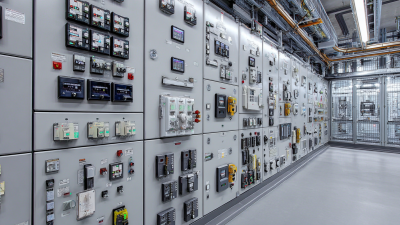
10 Best Power Control Systems for Global Buyers?
Global electricity systems are becoming more digital, distributed, and difficult to manage. The International Energy Agency projects electricity demand will grow by around 4% in 2024 and 2025, increasing pressure on transmission and distribution networks. For manufacturers, facility owners, and infrastructure contractors, reliable power control systems are no longer optional equipment. They influence voltage stability, energy efficiency, equipment protection, and operational continuity.
The IEA’s Electricity Grids and Secure Energy Transitions report estimates that annual grid investment must rise above USD 600 billion by 2030. It also warns that existing grids require extensive replacement and expansion. That reality changes how global buyers should compare suppliers. A compact control cabinet may look efficient, yet weak communication protocols or poor thermal design can create expensive failures in a hot, dusty plant room. Small details matter.
This guide reviews 10 best power control systems for global buyers, considering protection functions, automation compatibility, cybersecurity readiness, certification, service coverage, and lifecycle cost. The assessment draws on manufacturer documentation, international standards, and energy-sector research rather than headline specifications alone. However, no ranking is universally correct. A system designed for a European data center may perform poorly in a remote mining site without local support. That is the uncomfortable part. Buyers should verify every claim through factory testing, site conditions, maintenance records, and independent technical review before purchase.

What Power Control Systems Are and Why Global Buyers Need Them
Power control systems manage how electricity is generated, distributed, protected, and consumed. They may include switchgear, circuit breakers, sensors, protective relays, controllers, and monitoring software. Together, these components help maintain stable voltage, control loads, and isolate faults before equipment suffers serious damage. A practical system might detect an overload, disconnect one circuit, and keep a production line operating safely.
Global buyers face more than a purchase decision. Voltage, frequency, grid stability, environmental conditions, and installation practices differ between markets. A system designed for one region may perform poorly elsewhere without suitable configuration. Buyers should request test reports, wiring diagrams, operating limits, and maintenance instructions. Independent verification is valuable when specifications appear unusually optimistic. Small details matter.
Reliability also depends on local support. Spare parts, technician training, remote monitoring, and response times can influence total operating costs. Cybersecurity deserves attention when controls connect to business networks or cloud services. In procurement reviews, engineers should check recognized safety requirements and confirm compatibility with existing equipment. No system is perfect. Even a well-tested design may need adjustment after installation, especially where power quality changes seasonally. That uncomfortable possibility should shape the contract, commissioning plan, and acceptance testing.
Core Components and Operating Principles of Power Control Systems
Power control systems begin with measurement. Voltage transformers, current sensors, frequency meters, and temperature probes capture electrical conditions inside switchboards and substations. A programmable controller then compares these readings with safe operating limits. It may open a breaker, adjust reactive power, or reduce noncritical loads within milliseconds.
The operating logic is straightforward. Sensors provide data. Controllers make decisions. Actuators change the circuit. Communication gateways connect local equipment with supervisory software. IEC 61850 describes structured communication for substation automation, helping devices exchange time-stamped information. According to IRENA’s Renewable Capacity Statistics 2024, renewable projects added 473 GW globally in 2023. This expansion increases the need for fast voltage, frequency, and power-flow control.
Protection relays remain essential. They detect overcurrent, short circuits, earth faults, and abnormal frequency before equipment suffers severe damage. The IEA’s Electricity 2024 report projects global electricity demand growth of about 3.3% in 2024 and 3.7% in 2025 and 2026. That pressure makes efficient control valuable, not optional. In practical commissioning, engineers test relay settings with simulated faults, inspect cable labeling, and verify emergency shutdown signals. Small wiring errors still happen. They can delay a correct response. Poorly tuned controls may also create oscillations instead of stability, especially when solar generation and battery storage change rapidly.
| Rank | Power Control System | Core Components | Operating Principle | Primary Control Functions | Typical Applications | Key Global-Buyer Evaluation Points |
|---|---|---|---|---|---|---|
| 1 | Distributed Control System (DCS) | Controllers I/O modules Operator stations Industrial networks | Distributes control functions among networked controllers while providing centralized monitoring and supervisory operation. | Continuous process control, PID regulation, alarm management, interlocks, sequence control, and data logging. | Power generation, water treatment, chemical processing, and large continuous-production facilities. | Check redundancy architecture, network protocols, cybersecurity functions, lifecycle support, environmental ratings, and compliance with applicable electrical and functional-safety requirements. |
| 2 | Programmable Logic Controller (PLC) System | CPU Digital/analog I/O Programming software HMI | Executes a stored control program in repeated scan cycles to process inputs and update outputs. | Machine sequencing, motor control, interlocking, discrete automation, PID loops, and equipment diagnostics. | Industrial machinery, switchgear automation, pumping stations, manufacturing lines, and utility equipment. | Verify I/O voltage compatibility, scan time, expansion capacity, IEC 61131-3 programming support, communication interfaces, spare-part availability, and local service capability. |
| 3 | Supervisory Control and Data Acquisition (SCADA) | SCADA server HMI RTUs/PLCs Historian | Collects field data through remote terminal units or controllers and presents it for centralized supervision, analysis, and remote commands. | Real-time visualization, alarm handling, trend analysis, event recording, remote switching, and reporting. | Transmission grids, substations, pipelines, renewable-energy sites, and geographically distributed assets. | Assess communications resilience, time synchronization, remote-access security, data retention, protocol support, and compatibility with local grid-control requirements. |
| 4 | Energy Management System (EMS) | Power meters Forecasting tools Optimization engine Control gateway | Uses real-time measurements, forecasts, operating constraints, and optimization algorithms to coordinate energy production, consumption, and exchange. | Load forecasting, peak-demand management, economic dispatch, demand response, power scheduling, and energy reporting. | Commercial facilities, industrial sites, utilities, microgrids, and facilities with on-site generation. | Review interval data requirements, utility-market compatibility, tariff-model support, measurement accuracy, cybersecurity, cloud or on-premises options, and integration with meters and inverters. |
| 5 | Microgrid Control System | Microgrid controller Protection relays Meters DER interfaces | Coordinates distributed energy resources and loads in grid-connected or islanded operation while maintaining voltage, frequency, and power balance. | Grid synchronization, islanding detection, black start coordination, load shedding, generator dispatch, and reconnection. | Campuses, remote communities, critical facilities, industrial parks, and renewable-energy installations. | Confirm islanding and reconnection performance, protection coordination, local-grid rules, black-start capability, renewable intermittency handling, and interoperability with storage and generation assets. |
| 6 | Automatic Transfer and Emergency Power System | Automatic transfer switch Source sensors Control relay Generator interface | Monitors the normal power source and transfers connected loads to an alternate source when voltage, frequency, or phase conditions fall outside configured limits. | Source transfer, generator start signaling, retransfer, time delays, load prioritization, and emergency power continuity. | Hospitals, data centers, commercial buildings, industrial plants, and life-safety systems. | Check rated voltage and current, short-circuit withstand, transfer time, open or closed transition, neutral switching, phase-monitoring functions, and relevant installation standards. |
| 7 | Uninterruptible Power Supply (UPS) System | Rectifier Battery system Inverter Static bypass | An online double-conversion UPS converts incoming AC to DC and then back to regulated AC, with stored energy supporting the load during interruptions. | Voltage regulation, frequency stabilization, ride-through, power conditioning, bypass operation, and controlled shutdown support. | Data centers, medical equipment, telecommunications, industrial control systems, and laboratory equipment. | Evaluate topology, kVA and kW ratings, autonomy time, battery chemistry, efficiency at partial load, bypass behavior, harmonic performance, maintenance access, and regional safety requirements. |
| 8 | Battery Energy Storage Power Conversion System (PCS) | Bidirectional inverter DC protection AC switchgear Battery management interface | Converts AC power to DC to charge batteries and converts DC back to synchronized AC during discharge, following dispatch and grid-support commands. | Peak shaving, energy shifting, frequency response, voltage support, renewable smoothing, and backup power. | Utility-scale storage, commercial energy storage, renewable plants, microgrids, and industrial facilities. | Confirm bidirectional power rating, round-trip efficiency, grid-forming or grid-following mode, ramp rate, state-of-charge control, thermal management, protection coordination, and battery-system compatibility. |
| 9 | Variable-Frequency Drive (VFD) System | Rectifier DC link Inverter Motor controller | Adjusts motor speed and torque by controlling the frequency and voltage supplied to an AC motor, commonly through pulse-width modulation. | Motor speed control, soft starting, torque regulation, energy savings, process control, and regenerative braking when supported. | Pumps, fans, compressors, conveyors, HVAC systems, and process machinery. | Check motor compatibility, input harmonics, EMC performance, overload capacity, braking method, enclosure rating, cooling requirements, altitude limits, and regional supply voltage and frequency. |
| 10 | Power Factor Correction and Active Harmonic Filtering System | Power capacitors or active converter Current sensors Controller Protection devices | Measures reactive and distorted current and injects compensating current, or switches capacitive steps, to improve power factor and reduce harmonic current. | Reactive-power compensation, harmonic mitigation, voltage-support assistance, reduced apparent power demand, and improved power quality. | Industrial plants, commercial buildings, data centers, welding facilities, and sites with nonlinear loads. | Review target power factor, harmonic spectrum, detuning requirements, response time, load variability, short-circuit level, capacitor-resonance risk, thermal limits, and power-quality measurement methods. |
Key Types of Power Control Systems for Different Applications
10 Best Power Control Systems for Global Buyers?
Power control systems differ by application, load behavior, and local grid conditions. Industrial motors often need variable frequency drives, which regulate speed and reduce mechanical stress. Sensitive servers require uninterruptible power systems with battery backup and clean voltage output. Automatic transfer systems suit hospitals and factories that cannot tolerate long outages. Power factor correction equipment can reduce reactive demand, especially in plants with many motors or transformers.
Microgrid controllers coordinate solar generation, batteries, diesel generators, and priority loads. Building energy management systems focus on scheduling, metering, and demand response.
Direct-current distribution can also serve telecom rooms and data centers efficiently. The IEA Electricity 2024 report forecasts global electricity demand growth of about 3.4% annually from 2024 to 2026.
That increase makes accurate monitoring less optional. The IEA World Energy Investment 2024 report estimates current global grid investment near 400 billion dollars yearly, while investment may need to rise toward 600 billion dollars by 2030.
Selection should begin with measured load profiles, fault levels, ambient temperature, and maintenance skills. IEC 60364 and IEC 62040 provide useful safety and UPS guidance.
Commissioning teams often discover that a correctly sized system still fails because sensors were poorly placed. That detail is easy to miss.
Remote monitoring improves visibility, but it cannot replace physical inspections. A practical design also needs spare capacity, clear bypass procedures, and compatible protection settings. No ranking fits every buyer; a mining site and a medical laboratory should not share the same control philosophy.
How to Evaluate Safety, Efficiency, Compatibility, and Scalability
10 Best Power Control Systems for Global Buyers?
A reliable power control system should be judged beyond its catalog rating. During equipment evaluations, I check enclosure strength, overload protection, thermal limits, grounding, and emergency shutdown behavior. A unit installed near dust, humidity, or heat needs suitable protection, not optimistic assumptions. Safety records should include test results, maintenance intervals, fault logs, and clear installation instructions. Regional electrical requirements also matter. A system that passes one market’s expectations may need additional verification elsewhere.
Efficiency requires more than a high headline percentage. Measure performance at roughly 30%, 70%, and full load, because real facilities rarely operate at one level. Check standby consumption, heat output, power factor, and harmonic distortion. A cooler cabinet can reduce ventilation costs. Small losses become expensive across thousands of operating hours. I once focused too heavily on maximum output and overlooked idle consumption. That comparison was incomplete.
Compatibility begins with voltage, frequency, phase, connector type, and communication protocol. Confirm these details before purchasing samples. Also test integration with existing sensors, meters, and control software. For scalability, look for modular capacity, accessible spare parts, firmware support, and expansion without replacing the main cabinet. A practical trial should include load changes, network interruptions, and restart procedures. Documentation must be understandable to local technicians. That is often underestimated. Ask how service works across borders, including response times, training, and replacement logistics. A system may be technically impressive yet difficult to support.
Global Purchasing Factors: Standards, Suppliers, Costs, and Support
10 Best Power Control Systems for Global Buyers?
Global buyers should evaluate power control systems against local voltage, frequency, enclosure ratings, and safety requirements. A system designed for 480 volts may fail in a 400-volt facility. Check IEC or equivalent regional standards, conformity documents, test reports, and protection ratings before requesting quotations. Ask for wiring diagrams and sample inspection records. Paperwork matters.
Supplier capability deserves equal attention. Review factory experience, production capacity, quality controls, and response times for technical questions. A reliable supplier should explain overload protection, temperature limits, communication interfaces, and spare-part availability in clear language. Request a video inspection or an independent pre-shipment inspection when the order is large. I once focused too heavily on specifications and overlooked training support. That mistake created avoidable commissioning delays.
Purchase price rarely shows the full cost. Compare installation labor, energy losses, maintenance intervals, replacement components, software access, and shipping insurance. Ask whether technicians can provide remote troubleshooting across time zones. Confirm warranty conditions and realistic repair timelines in writing. Keep critical spare units nearby. It costs more initially. Yet downtime can cost much more. Suppliers may also quote excellent support but provide slow replies after payment. This risk deserves a practical test: send several technical questions before ordering and measure the quality, accuracy, and speed of each response.
10 Best Power Control Systems for Global Buyers
Global purchasing benchmark based on standards fit, supplier availability, lifecycle cost transparency, integration complexity, and after-sales support. Scores are normalized from 0 to 100 and are intended for procurement comparison rather than market-share measurement.
Buyers should verify applicable requirements under standards such as IEC 61439 for low-voltage assemblies, IEC 60204-1 for machinery electrical equipment, IEC 61800-5-1 for adjustable-speed drives, IEC 62040-1 for UPS systems, IEC 62477-1 for power electronic systems, and IEC 61000 for electromagnetic compatibility. Final selection should also consider local voltage, frequency, grid codes, installation conditions, spare parts, commissioning, and long-term technical support.
Related Posts
-
Understanding the Future of Power Control Systems in Smart Grid Technology
-

2025 Top Power Control Systems: Innovations Driving Efficiency and Reliability
-

How to Choose the Best Electrical Control Systems for Your Needs?
-
7 Tips for Choosing the Right PLC Control Panel
-
What is an Automation Control Panel and How Does it Work?
-
Exploring the Evolution of Control Panels: Industry Insights and Future Trends in Automation Technology