How to Choose the Best Foldable Pet Cot?
Choosing the best Foldable Pet Cot starts with your pet’s size, habits, and usual resting place. A cot should support your pet comfortably without leaving paws crowded near the edge. Measure your pet while lying down, then compare those measurements with the cot’s usable sleeping area. Check the manufacturer’s stated weight limit, too. A wide-looking frame is not automatically suitable. The fabric and support bars matter just as much.
Comfort matters. Look for a breathable sleeping surface that feels comfortable against your pet’s body and is easy to clean. Check how the frame locks open and folds closed. A wobbly leg or awkward latch can make an otherwise practical cot frustrating. On a smooth floor, rubber feet may help limit sliding; outdoors, uneven ground can make stability harder to judge. Small details count.
Think about where you will carry and store it. Compare the folded dimensions and weight with your car space, closet, or travel bag. A lightweight cot is convenient, but it still needs a frame suited to your pet’s size. It is easy to focus on price or appearance and miss the measurements. I would pause there. Before buying, review the product specifications and care instructions, then observe how your pet approaches a similar raised surface. Some pets need time to adjust. The best choice is the one that fits your pet and your routine, not simply the one that folds fastest.
Identify Foldable Cot Types, Frame Designs, and Load-Rating Specifications
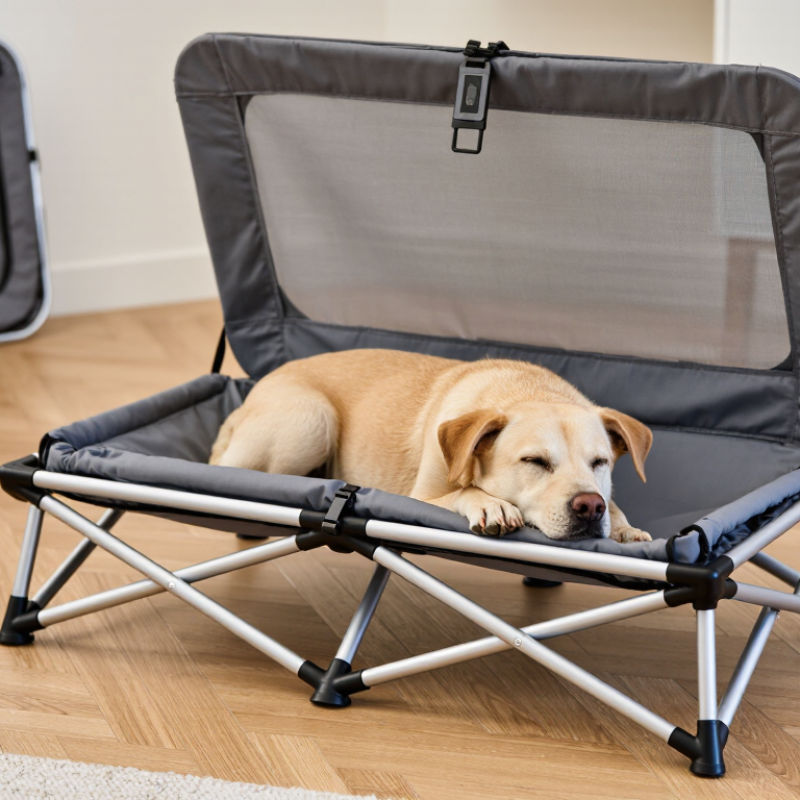
Foldable pet cots usually fall into two types: raised beds with fabric stretched across a frame, and low-profile mats that fold for storage. Raised designs allow air to move beneath a pet and can keep bedding off a cool floor. Low mats may suit older pets that prefer stepping onto a smaller height. Try the cot indoors. A picture rarely shows how easily a dog can climb aboard.
Frame design affects stability and setup. Tubular steel often feels firm but adds weight; aluminum is lighter, though joints still need careful inspection. Look for locking hinges, reinforced corners, and feet that sit evenly on the floor. Fabric should remain taut without sagging under a pet’s usual resting position. A frame may look sturdy and still wobble on tile. Check it on the surface where it will actually be used.
Read the stated load rating, not just the product’s appearance. Choose a rating comfortably above your pet’s weight, especially if the animal tends to jump onto the cot. Ratings can vary by design and testing method, so follow the maker’s instructions and check whether the limit includes movement. Press the center gently before use, then inspect seams, joints, and locks regularly. A small detail can matter. If your pet is still growing, reassess the fit and capacity later.
Size the Sleeping Surface: Add 10–15 cm to Your Pet’s Body Length
Measure your pet from the nose to the base of the tail while standing naturally. Add 10–15 cm to that length for the cot’s usable sleeping surface. This gives your pet room to stretch without leaving excessive empty space. Check the inside dimensions, not the outer frame; fabric seams and raised edges can reduce the flat area.
The American Pet Products Association’s 2023–2024 National Pet Owners Survey estimated that 65 million U.S. households owned dogs and 46.5 million owned cats. Those figures describe a wide range of sizes, not a universal cot measurement. Measure your own pet instead. A soft tape can sag, so repeat the measurement and use the longer reliable result. Small detail. Big difference.
A common mistake is measuring a curled-up pet. That posture can make the cot seem roomy until your pet stretches out at night. If your pet sleeps stretched, check that the surface also accommodates the shoulders and hips. For a foldable cot, verify the listed sleeping area after setup; the fabric may pull taut or dip slightly. I would leave a little extra room for a growing puppy, but not so much that the pet slides around.
Match the Cot’s Rated Capacity to Your Pet’s Weight and Occupancy
How to Choose the Best Foldable Pet Cot?
Match the cot’s rated capacity to your pet’s actual weight, not a rough guess. The Association for Pet Obesity Prevention’s 2022 survey estimated that 59% of dogs and 61% of cats were overweight or obese. Those figures make regular weighing useful, even when a pet looks small beside the cot. Measure, don’t guess. Use a household scale or ask your veterinary clinic for a current weight.
Check whether the cot is intended for one pet or shared use. For two pets, add their weights together before comparing the total with the stated capacity. A 30-pound combined load means a cot rated for only 25 pounds is unsuitable, even if both animals fit on the fabric. Choose a capacity above their combined weight, and follow the manufacturer’s loading instructions. Jumping onto a cot can place extra stress on its frame.
Also check the sleeping surface dimensions. A cot can meet the weight rating yet feel cramped when pets curl up together. Look for the capacity label and inspect hinges, joints, and feet for looseness before use. Ratings and designs vary, so avoid assuming that two similar-looking frames support the same load. Even careful estimates can be off. Reweigh growing puppies or pets whose weight changes, then reassess the cot’s capacity.
How to Choose the Best Foldable Pet Cot? — Match the Cot’s Rated Capacity to Your Pet’s Weight and Occupancy
Start with the combined weight of every pet that may use the cot at the same time. The examples below use a conservative 1.5× screening calculation to help compare rated capacities; it is a planning aid, not a universal safety standard.
| Example Occupancy | Pet Weight | Combined Weight | Capacity Screening Target
(Combined Weight × 1.5) | Example Rated Capacity to Look For |
| One small dog | 4 kg (8.8 lb) | 4 kg (8.8 lb) | At least 6 kg (13.2 lb) | 10 kg (22 lb) or higher |
| One medium dog | 18 kg (39.7 lb) | 18 kg (39.7 lb) | At least 27 kg (59.5 lb) | 30 kg (66 lb) or higher |
| One large dog | 35 kg (77.2 lb) | 35 kg (77.2 lb) | At least 52.5 kg (115.7 lb) | 60 kg (132 lb) or higher |
| Two cats sharing the cot | 4.5 kg (9.9 lb) each | 9 kg (19.8 lb) | At least 13.5 kg (29.8 lb) | 15 kg (33 lb) or higher |
| Two medium dogs sharing the cot | 12 kg (26.5 lb) each | 24 kg (52.9 lb) | At least 36 kg (79.4 lb) | 40 kg (88 lb) or higher |
| One 20 kg dog and one 10 kg dog | 20 kg (44.1 lb) and 10 kg (22 lb) | 30 kg (66.1 lb) | At least 45 kg (99.2 lb) | 50 kg (110 lb) or higher |
Before buying: Check the cot’s stated maximum load and whether it applies to the whole cot or to each sleeping area. Use the combined weight for shared occupancy, follow the manufacturer’s instructions, and allow for pets shifting, jumping, or moving together. Also confirm that the sleeping surface is large enough for all intended occupants.
Compare Fabric Wear Data Using ASTM D4966 Martindale Abrasion Tests
How to Choose the Best Foldable Pet Cot?
Compare Fabric Wear Data Using ASTM D4966 Martindale Abrasion Tests
A cot’s fabric faces repeated friction from paws, claws, and shifting weight. ASTM D4966 Martindale testing gives buyers a useful way to compare abrasion resistance under controlled conditions. A fabric sample rubs against an abrasive surface in repeated cycles, with wear assessed according to the test procedure. Ask for the reported cycle count, test endpoint, and fabric details—not just a claim that material is “heavy duty.” Compare like with like: different fabrics, coatings, and test conditions can make numbers misleading. Useful, but incomplete.
A higher abrasion result may suggest better resistance to surface wear, but it cannot predict exactly how long a cot will last at home. The test does not measure frame stability, seam strength, washing damage, or a pet repeatedly chewing one spot. Look beyond the number. Check whether the fabric feels tightly woven, whether seams are reinforced, and whether the folded frame locks securely. If available, compare test reports for the same fabric construction and ask how results were obtained. A clear report is more helpful than a broad durability promise. Even then, the best choice depends on your pet’s size, habits, and where the cot will be used. A calm indoor sleeper and an energetic outdoor dog may need very different fabrics.
How to Choose the Best Foldable Pet Cot?
Compare fabric abrasion resistance using the ASTM D4966 Martindale test. Higher cycle counts indicate greater abrasion resistance in this example.
Note: Values are illustrative, not laboratory results or ASTM-certified ratings. Actual results depend on the fabric construction, test conditions, and failure endpoint. Compare cot fabrics using test reports produced under the same conditions.
Check Fabric Strength Using ASTM D5034 Grab-Test Results
How to Choose the Best Foldable Pet Cot?
A fabric’s appearance can be misleading. A tightly woven cot cover may still tear when a dog shifts its weight or paws at the edge. Ask for ASTM D5034 grab-test results. This method measures the force needed to break a fabric specimen held in the test jaws. Results can help compare fabrics, but they are not a guarantee of cot lifespan.
Check that the report identifies the fabric, test direction, units, and conditioning method. Warp and weft results may differ, so a single figure can hide a weak direction. Compare results from the same test method rather than treating one number as a universal pass mark. Also inspect seams, reinforced corners, and attachment points; the fabric panel is only part of the cot. Real use is messier than a lab test. That matters.
Tips: Look for results in both fabric directions, and ask how many samples were tested. Press the cot fabric with your thumb, then inspect stitching near the frame. If the report is unclear, pause before buying. A strong grab-test result is useful evidence, not the whole answer.

