How to Choose the Best Automation Panels for Your Business Needs in 2025
In an increasingly automated world, selecting the right automation panels is crucial for businesses looking to optimize efficiency and productivity in 2025. As industries continue to evolve, the demand for sophisticated control systems grows, making it essential for business leaders to understand the features and capabilities of different automation panels. These panels not only streamline operations but also offer enhanced flexibility and scalability tailored to specific business needs.
As organizations strive to stay competitive, the choice of automation panels can significantly impact operational workflows and cost management. Navigating through the myriad of available options requires a strategic approach, considering factors such as compatibility with existing systems, ease of use, and the level of support and service provided by manufacturers. Furthermore, addressing future technological advancements and industry trends is vital, ensuring that the selected automation panels will meet the evolving demands of the marketplace.
In this guide, we will delve into the key considerations for choosing the best automation panels for your business needs, equipping you with the knowledge to make informed decisions that will lead to sustained growth and success in the dynamic landscape of 2025.

Understanding the Role of Automation Panels in Modern Businesses
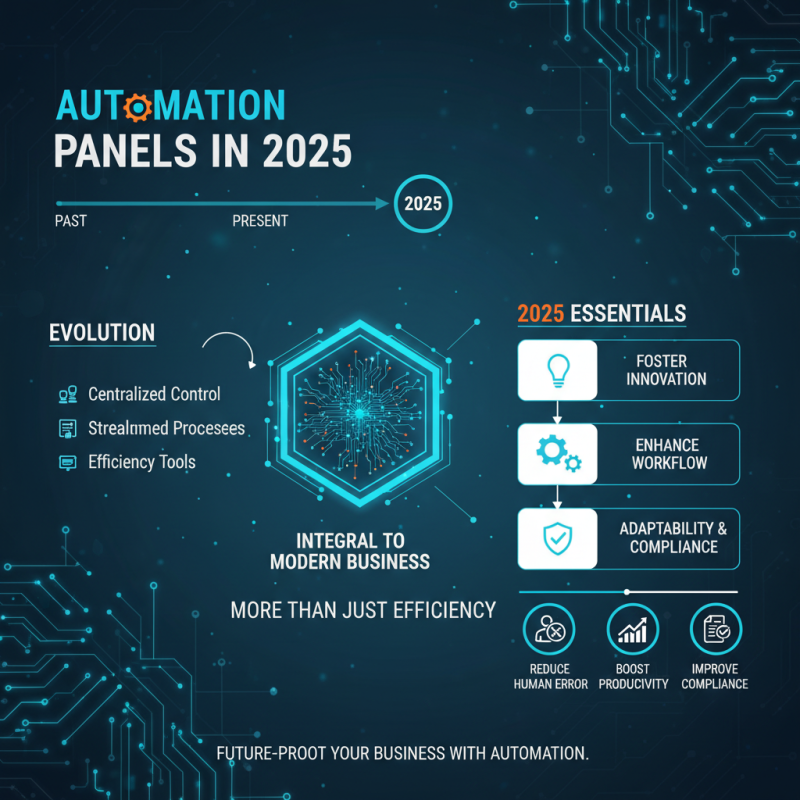
Automation panels are increasingly becoming integral to the operational framework of modern businesses. These panels serve as centralized control systems that streamline various processes, enabling organizations to operate more efficiently. In 2025, businesses must recognize that automation panels are not just tools for efficiency but are essential for fostering innovation and adaptability in a fast-changing market. By integrating automation panels, companies can enhance their workflow, reduce human error, and ensure better compliance with industry standards.
Understanding the role of automation panels goes beyond recognizing their functional benefits; it involves appreciating how they contribute to strategic business goals. Modern businesses are under constant pressure to innovate and保持 competitive. Automation panels facilitate data analytics and monitoring, allowing decision-makers to gain real-time insights into operations. This capability empowers organizations to make informed decisions quickly, optimize resource allocation, and improve overall productivity. As businesses navigate the complexities of the digital era, choosing the right automation panel will be vital in supporting their long-term objectives and helping them stay ahead of the competition.
Identifying Key Business Needs for Automation Solutions
Identifying the key business needs for automation solutions is essential for companies looking to enhance operational efficiency and drive growth in 2025. Recent studies indicate that over 50% of businesses cite increased productivity as a primary driver for automation implementation. This underscores the necessity of carefully assessing specific operational pain points that can be alleviated through automation, such as time-consuming manual processes or error-prone data entry. Organizations should invest time in mapping their workflows to determine which areas would benefit the most from automation, allowing them to select automation panels that align closely with their unique needs.
In addition to productivity, organizations must consider their scalability requirements. According to a report by McKinsey, businesses that leverage automated solutions can scale their operations up to 60% more efficiently compared to those that do not. This highlights the importance of choosing automation panels that not only address current operational challenges but also are flexible enough to adapt to future growth. Companies should evaluate the integration capabilities and user-friendliness of the automation tools to ensure they can easily accommodate expansion and evolving business processes, thereby creating a robust, future-proof infrastructure.
Evaluating Different Types of Automation Panels Available in 2025
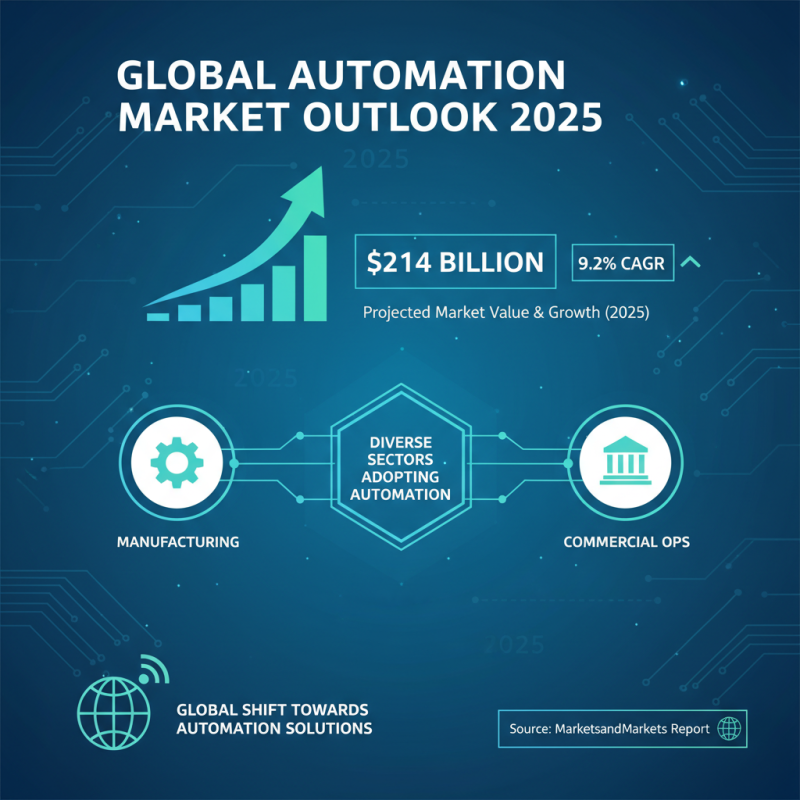
When evaluating different types of automation panels for your business needs in 2025, it is essential to understand the various features and technologies that are driving the industry. According to a report by MarketsandMarkets, the global automation market is projected to reach $214 billion by 2025, showcasing a compound annual growth rate (CAGR) of 9.2%. This growth indicates a significant shift toward the adoption of automation solutions across diverse sectors, including manufacturing, logistics, and commercial operations.
One pivotal category of automation panels includes programmable logic controllers (PLCs), which are crucial for controlling machinery and industrial processes. A recent study by Technavio found that the PLC market is expected to grow by 17% annually through 2025, emphasizing the increasing reliance on these systems for real-time decision-making and process optimization. Additionally, human-machine interfaces (HMIs) play a critical role in user interaction with automation systems. The demand for intuitive HMIs that integrate advanced analytics and machine learning capabilities is rising, as businesses seek to enhance usability and efficiency.
Furthermore, with the burgeoning interest in sustainable practices, automation panels equipped with energy monitoring features are becoming necessary. According to a report from Allied Market Research, the demand for energy-efficient automation solutions is anticipated to drive a 27% increase in the adoption of smart automation technologies by 2025. Therefore, when choosing the right automation panel for your business, it is vital to consider these technological trends and align them with your specific operational goals.
Assessing Compatibility with Existing Systems and Technology
When selecting automation panels for your business in 2025, one of the foremost considerations is compatibility with existing systems and technology. Recent data from industry reports indicate that over 65% of businesses experience challenges due to integration issues when introducing new automation technologies. This statistic underscores the importance of evaluating how new panels will communicate with current hardware and software infrastructures. Ensuring compatibility not only reduces downtime during implementation but also maximizes the return on investment by enabling seamless workflows.
Moreover, it is essential to assess the scalability of automation panels in relation to existing systems. A study by the International Society of Automation (ISA) found that organizations that prioritize compatibility see a 30% reduction in operational disruptions. Technologies should not only fit into current workflows but also offer the flexibility to adapt to future expansions or system upgrades. Therefore, focusing on open protocols and standardized communication methods can further enhance the longevity and efficiency of automation solutions, leading to a more robust operational framework.
Cost-Benefit Analysis of Automation Panels for Your Business
When considering automation panels for your business in 2025, conducting a
cost-benefit analysis is essential. This process involves evaluating both the
initial investment and the long-term savings associated with automation. Businesses often overlook indirect benefits, such as improved efficiency,
reduced labor costs, and enhanced accuracy. By calculating these aspects, you can make a more informed decision that aligns with your operational goals.
Tips: Start by estimating the upfront costs including installation, training, and maintenance. Then, project the potential savings over time,
accounting for aspects like reduced error rates and increased productivity. Additionally, consider scalability;
choose automation panels that can grow with your business needs. This foresight can amplify your investment, ensuring that the automation tools
you choose remain relevant and cost-effective in the coming years.
Moreover, remember to assess the return on investment (ROI) for the automation panels. A higher ROI indicates not just profitability
but also strategic alignment with business objectives. Identify specific metrics that reflect both quantitative
benefits, such as time saved, and qualitative improvements, like employee satisfaction, to create a comprehensive analysis. Employing these insights
will empower you to select automation panels that provide real, measurable value to your operation.