How to Choose the Right Motor Power for Your Project?
Choosing the right motor power for your project is crucial. The right power can enhance efficiency and performance. However, many overlook this essential step. Selecting an inadequate motor power can lead to inefficient operations. It may even cause project failure.
When assessing motor power, consider your project's specific needs. For instance, a small robot might require less power than a heavy-duty conveyor system. Each application is unique. A common mistake is assuming that bigger is always better. Too much power can waste energy and incur higher costs.
Reflect on your project's requirements. Look at the load, speed, and torque needed. These factors directly influence motor power. Understanding these details will help you avoid potential issues. Balancing the right motor power with project demands requires careful thought and research. It's not always straightforward, and sometimes mistakes can teach valuable lessons.

Understanding Motor Power Ratings and Their Importance in Applications
Choosing the right motor power is essential for your project's success. Understanding motor power ratings helps in applications across various fields. These ratings indicate how much work a motor can perform, measured in watts or horsepower. A higher rating usually means more power, but it isn't always necessary. For lighter tasks, lower power motors can suffice.
When selecting a motor, consider the specific requirements of your application. What is the load? What speed do you need? These factors influence motor choice significantly. Sometimes, people overlook motor efficiency. A less powerful but efficient motor might outperform a more robust unit, saving energy and costs in the long run.
**Tips:** Always calculate the load requirements before making a decision. Don't guess the specifications. If uncertain, consult with others. Look for feedback and reviews from users in similar applications. Self-reflection can also help. Have you thought critically about your needs? A small motor might seem insufficient, but in practice, it could be ideal.
Motor Power Ratings for Different Applications
This chart illustrates the typical power ratings (in Watts) required for various applications, helping you determine the right motor power for your project.
Factors Influencing Motor Power Selection: Torque, Speed, and Load Considerations
Choosing the right motor power for your project involves careful consideration of torque, speed, and load. Torque is the force needed to rotate an object. You must measure the required torque for your specific use. Too little torque can lead to inefficiency. Too much torque might waste energy.
Speed is another critical factor. Motors operate at various speeds. Ensure the motor speed matches your project needs. Sit down and calculate the optimal RPM. If a motor spins too fast or too slow, it won't function efficiently. This mismatch can also cause wear and tear.
Tip: Always document your calculations. Sometimes you may overlook minor details that affect performance. Understand your load requirements thoroughly. A motor struggling under a heavy load could overheat, which is dangerous. Pay attention to load variations as well. Regularly evaluate it during operation. Adjustments may be necessary. This attention to detail will yield better results in the long run.
Evaluating Project Requirements: Calculating Power Needs for Efficiency
Choosing the right motor power for a project is crucial for efficiency. It directly impacts performance and energy consumption. To accurately calculate power needs, start by understanding your project's demands. Consider factors like load, speed, and torque requirements. The National Electrical Manufacturers Association (NEMA) states that optimal motor efficiency can improve energy savings by 3-5%.
Tips: Always account for future project variations. Overestimating power needs can lead to inefficiencies. Underestimating might cause equipment failure.
When evaluating motor power, analyze the specific applications involved. For instance, a conveyor system requires different power than a pump. Always review the load characteristics. The motor's duty cycle also matters. Continuous duty motors operate differently than intermittent ones. Be sure to factor in ambient temperatures, which can affect performance.
Tips: Don't forget to measure real-world conditions. Bench tests can reveal discrepancies between theoretical calculations and actual performance. Revisit your calculations if operations change significantly.
How to Choose the Right Motor Power for Your Project?
| Project Type |
Power Requirement (W) |
Optimal Motor Type |
Efficiency Rating |
| Conveyor Belt |
500 |
AC Induction Motor |
80% |
| Electric Car |
15000 |
Permanent Magnet Motor |
95% |
| Pumping Station |
2000 |
Submersible Motor |
85% |
| Robotics |
200 |
Stepper Motor |
90% |
| CNC Machine |
1000 |
Servo Motor |
92% |
Comparing AC and DC Motors: Which Type Suits Your Project Best?
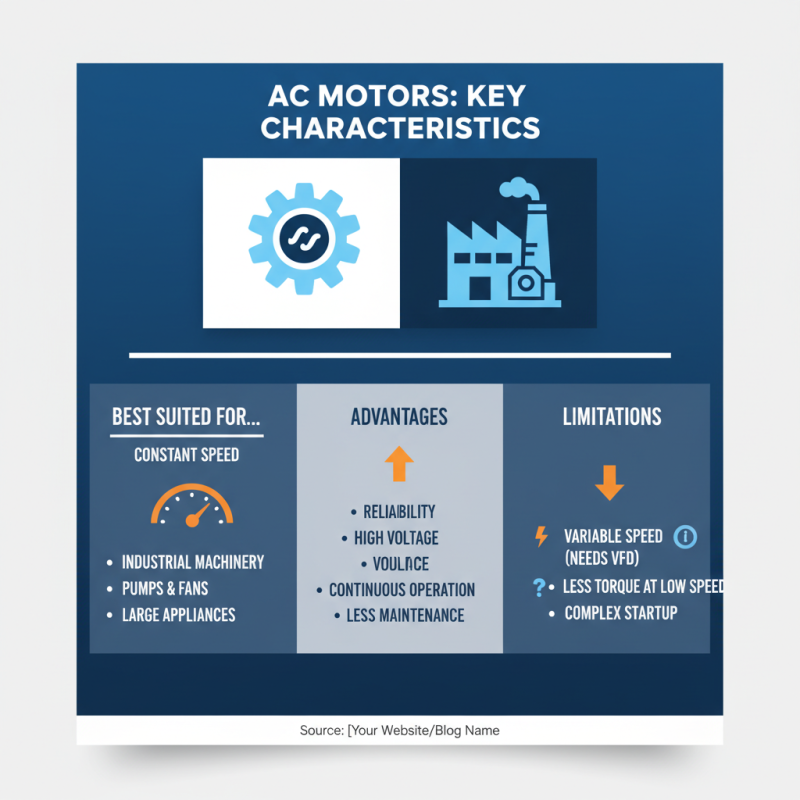
When selecting between AC and DC motors, it's essential to understand their fundamental differences. AC motors are typically used in applications needing consistent speed. They excel in powering larger machines found in industrial settings. These motors offer reliability at higher voltages, making them suitable for continuous operation. However, they might not perform well in variable speed applications without additional equipment.
In contrast, DC motors are favored for their precise speed control. They are ideal for applications requiring variable speed and torque. A common example is electric vehicles, where instant torque is crucial. Yet, they need more maintenance due to brushes and commutators. Additionally, the power supply can complicate design, as they require batteries or converters.
Both types have merits and limitations. It's about aligning your project's needs with the motor's capabilities. Reflect on factors like ease of control, efficiency, and application environment. This oversight often leads to suboptimal choices. Evaluating these details can guide you toward the right motor power for your project.
Industry Standards and Guidelines for Motor Power Specifications
When selecting the right motor power for your project, industry standards play a crucial role. According to recent reports, matching motor capacity with application requirements ensures optimal performance. The National Electric Manufacturers Association (NEMA) provides guidelines, emphasizing efficiency ratings. For example, a motor rated at 90% efficiency can save significant energy costs over time.
Understanding your project's specific needs is essential. A mismatch in motor power can lead to excess energy consumption or inadequate performance. The International Electrotechnical Commission (IEC) suggests considering factors like load, duty cycle, and environmental conditions. A mismatch can lead to overheating or mechanical failure.
Tips: Always consult efficiency charts to enhance decision-making. Consider load variations and peak demands. A well-matched motor can lead to better energy savings and longer service life. Continually revisiting your specifications can help refine your choices. Understand that there may not be a one-size-fits-all solution.