How to Choose a Silicone Cookie Spatula for Bulk Orders
A Silicone Cookie Spatula can look convincing in a product photo yet struggle beneath a warm, delicate cookie. For bulk buyers, that difference can mean broken batches, customer complaints, and inventory that moves slowly. Details matter. A thin, tapered edge should slide under cookies without tearing their centers or scraping the baking surface. The head also needs enough support to lift a large cookie without folding. Choosing well means balancing flexibility, construction, documented material suitability, and the actual needs of your customers.
Start your evaluation with samples that reflect the exact materials and construction proposed for production. Test them on soft chocolate chip cookies, crisp butter cookies, and heavier cookies loaded with nuts. Check the handle joint for movement and inspect seams where dough or wash water could collect. Ask suppliers for food-contact compliance documentation relevant to your destination market, with clear identification of the tested material or product. A stated heat rating needs supporting evidence and clear use conditions. Claims need checking. Dishwasher suitability, odor retention, and handle comfort deserve attention too, especially when the spatula will see repeated daily use.
Bulk purchasing also brings practical questions about minimum quantities, packaging dimensions, lead times, and inspection criteria. A lower unit price may lose its appeal if oversized cartons increase freight costs or inconsistent edges cause returns. There is no perfect specification for every buyer, and an attractive sample cannot establish consistency across an entire shipment. Even a useful cookie test has limits. Use those findings to define measurable requirements, then agree on how production quality will be checked before shipment.
Understanding Silicone Cookie Spatula Types and Uses
Silicone cookie spatulas serve different tasks, so bulk orders should match actual baking routines.
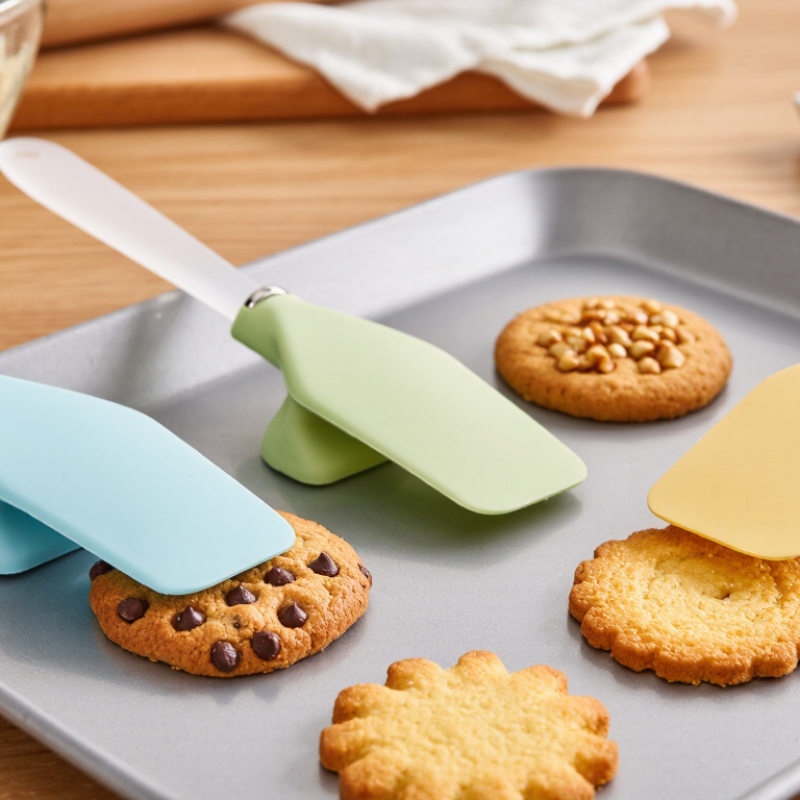
Thin, flexible turners slide beneath delicate cookies with less pressure on fragile edges. Wider heads support larger cookies, while narrow heads fit crowded trays. Scraper spatulas handle dough and bowl cleanup, but thick edges can struggle beneath baked cookies.
Shape matters. For purchasing specifications, record head width, edge thickness, handle length, and flexibility instead of relying on product names.
Material documentation deserves equal attention. Germany’s Federal Institute for Risk Assessment, in Recommendation XV on silicones, specifies a 0.5% limit for volatile organic components. This technical benchmark helps buyers assess documentation; it does not establish a spatula’s heat resistance or lifting performance.
Request testing that covers the finished utensil and its intended food-contact conditions. A seamless design also removes the head-to-handle joint where dough can collect. Still, seamless construction alone cannot prove durability.
Tips:
- Request samples with different head widths, then test them on your usual trays.
- Try warm, soft cookies and fully cooled batches. Check edge damage.
- A wider head may improve support, yet make closely spaced cookies harder to reach. That tradeoff deserves testing.
- For bulk approval, document sample dimensions and acceptable flex so later shipments can be checked against concrete requirements.
Defining Size, Flexibility, and Heat Resistance Requirements
For bulk orders, define blade dimensions around your actual cookies, trays, and packaging. A blade roughly 60–75 mm wide offers a practical starting point for testing medium cookies. Measure usable width. An oversized blade can crowd neighboring cookies on tightly packed trays. A narrow blade may leave soft cookies unsupported, increasing breakage during transfer. Specify handle length, too, especially when staff must reach across deep baking trays.
Flexibility needs a measurable purchasing specification, rather than descriptions such as “soft” or “professional.” Request samples with different blade thicknesses and compare them using the same cookie recipe. Test warm cookies. A thin edge should slide underneath without dragging, while the center should support the cookie during lifting. Greater flexibility is not always better; an overly soft blade may fold under a thick cookie. The ideal stiffness remains partly subjective, so record staff feedback alongside visible damage. An initial sample choice may need revision after a busy production shift.
Tips: Set heat resistance requirements from actual contact conditions, including hot trays and repeated washing. Ask suppliers for documented temperature limits, permitted contact duration, and relevant food-contact compliance evidence for your intended market. A maximum temperature alone does not establish suitability for prolonged contact. Inspect samples after repeated use for warping, cracks, or separation around any internal reinforcement. Include agreed dimensions, stiffness references, and acceptance criteria in the order specification. Keep one approved sample for comparison when the shipment arrives.
Comparing Bulk Pricing, Minimum Orders, and Customization Options
Bulk pricing for silicone cookie spatulas depends on quantity, packaging, and customization. Request quotes for 500, 1,000, and 3,000 units using identical specifications. Compare landed costs, including freight, duties, and setup fees. A lower unit price may disappear after individual boxes and logo charges are added. Check the fine print. Ask whether minimum order quantities apply per color, design, or total shipment. A 1,000-piece minimum becomes restrictive when each color requires a separate order.
Customization options can include molded logos, printed handles, custom colors, and retail sleeves. Ask suppliers to quote each option separately. Molded details may require tooling fees, while printed logos need durability checks. Request samples made with the proposed silicone formulation and handle construction. For small cookies, compare blade widths around 5–7 centimeters against your actual baking trays. Check flexibility, edge thickness, and handle grip. Request food-contact documentation relevant to your sales market, plus evidence supporting any advertised heat-resistance claim.
Tips: Approve a physical sample before authorizing production, especially when matching colors or checking logo placement. Photos hide flaws. Record acceptable color variation, packaging details, and delivery dates in the purchase agreement. A cheaper sample may feel adequate initially but prove awkward when lifting delicate cookies. Sample checks have limits, though. They cannot guarantee consistency across thousands of pieces, so agree on inspection criteria and defect remedies before paying a deposit.

