
How to Choose the Best Gradual Yarn Machine?

Choosing a Gradual Yarn Machine is not simply a matter of comparing speed or price. Buyers need to know whether a machine can produce the required color transition consistently, without damaging yarn or creating excessive waste. That matters.

Textile Exchange’s Materials Market Report 2024 estimates that global fiber production reached 124 million tonnes in 2023 and may grow to 169 million tonnes by 2030. These figures describe the wider fiber sector, not demand for gradient-yarn equipment. Still, they point to a growing need for flexible production and careful resource use. A machine’s real value depends on the yarn types, batch sizes, and color effects your mill actually handles.

This guide explains how to assess key specifications, including tension control, dye application, drying capacity, automation, and changeover time. It also considers practical details: Can the equipment handle your target yarn count? Does a sample run show a smooth transition under production conditions? Can the supplier provide service support and verifiable performance data? A brochure may look convincing. The yarn sample tells more.

There is no universal best machine. Some buyers may prioritize repeatability; others need quick shade changes or lower water and energy use. Published industry reports rarely compare individual machine models, so treat broad market data as context—not proof of performance. Ask for a trial using your own yarn, and record the results. Even then, one test cannot predict every production shift. That uncertainty deserves attention.
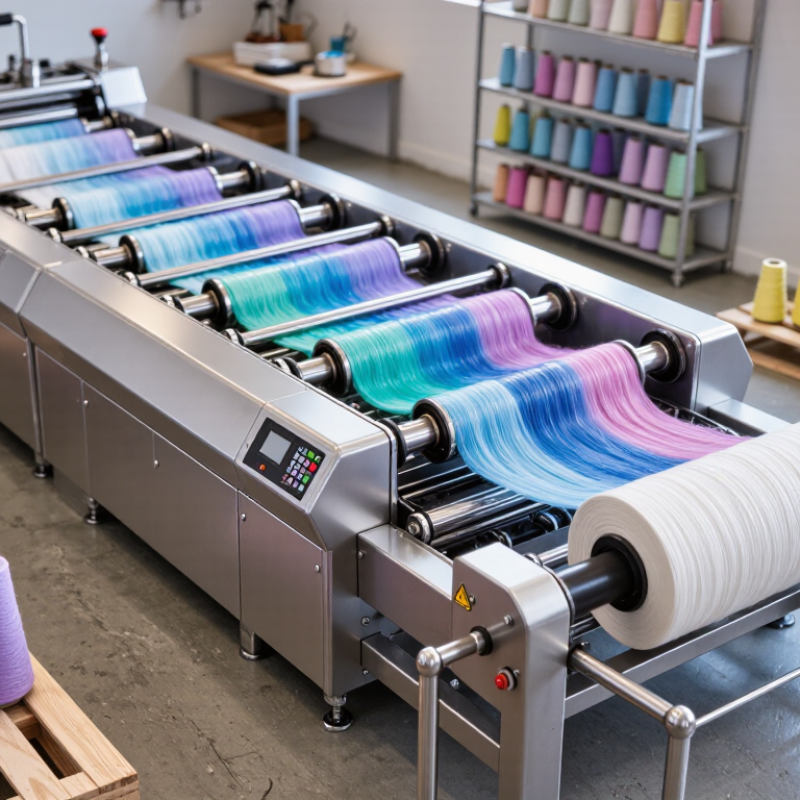
How to Choose the Best Gradual Yarn Machine?

Define Gradient Quality by Transition Length, Color Steps, and CIEDE2000 ΔE00

How to Choose the Best Gradual Yarn Machine?
Define Gradient Quality by Transition Length, Color Steps, and CIEDE2000 ΔE00

A convincing gradient depends on more than its starting and ending colors. Transition length describes how much yarn carries the color change. A short transition creates a sharper shift; a longer one produces a softer blend. Ask how precisely the machine controls this length, then inspect a finished sample under consistent lighting. Measure the yarn, not just the digital preview.

Color steps are the intermediate shades between the endpoints. Too few can create visible bands, especially on smooth yarn. More steps may look smoother, but they also require stable color control. CIEDE2000 ΔE00 helps quantify perceived color difference between neighboring shades; lower values generally indicate subtler changes. Compare readings using the same instrument, lighting conditions, and yarn material. A single ΔE00 target cannot guarantee a pleasing gradient, though. Texture and viewing distance matter.

Tips: Request a physical sample with marked transition length. Check adjacent color steps with a spectrophotometer, and view the yarn in daylight and indoor light. Small differences matter. Record settings and results across repeat runs. A neat chart can still mislead; the sample may reveal uneven transitions you did not expect.

How to Choose the Best Gradual Yarn Machine?

Compare transition length, programmable color intervals, and the average CIEDE2000 color difference between adjacent intervals.

Illustrative calculation, not machine test data: for a 40 cm transition with an endpoint difference of ΔE00 = 24, the bars show the approximate average difference per interval if color change is evenly distributed (24 divided by the interval count). A value near 1 can be a useful perceptibility reference under controlled viewing, but visibility depends on the colors and conditions. Since ΔE00 is not strictly additive, verify finished yarn with measured samples. Choose a machine that supports your required transition length and enough programmable intervals for smooth blends.

Match Feed Yarn Using Linear Density in tex and Package Dimensions

How to Choose the Best Gradual Yarn Machine?

Match Feed Yarn Using Linear Density in tex and Package Dimensions

Before choosing a gradual yarn machine, compare its recommended yarn range with the linear density of your feed yarn. Tex measures grams per 1,000 meters, so a higher tex value means heavier yarn. Check the machine’s specifications for supported tex ranges and feeding limits. A mismatch may cause unstable tension, uneven transitions, or frequent yarn breaks. Test the actual yarn whenever possible; labels alone may not reveal how it unwinds.

Package dimensions matter just as much. Measure the yarn package’s maximum diameter, height, core opening, and weight, then compare them with the holder’s clearance and capacity. Also check the required unwind direction and the space needed for the yarn to pay off smoothly. A package may fit on the spindle but still rub against a guide or create excessive yarn ballooning. Small differences can be easy to overlook.

Tips: Run a short trial at the intended production speed. Watch the yarn path, tension changes, and package movement during color or shade transitions. Record the tex and package measurements that perform reliably. A tidy specification sheet helps, but it can miss real-world friction or winding variation. That is worth checking.

Compare Machine Capacity in kg/batch, Liquor Ratio, and Temperature Range

How to Choose the Best Gradual Yarn Machine?

Compare capacity in kg per batch, liquor ratio, and temperature range before choosing a machine. Capacity should match your normal production lot, not just your largest one. A 100 kg rating may be less useful if your routine batches are 30 kg and need even circulation. Check the machine’s recommended minimum load, too. Small batches matter. Liquor ratio means the amount of dye liquor used per kilogram of yarn; a 1:8 ratio uses less liquor than 1:12, if the process can maintain even wetting. Actual requirements vary with yarn type, package density, and dye recipe. The World Bank’s 2019 overview cites estimates that textile dyeing and treatment account for 17–20% of industrial wastewater pollution. This makes water use worth checking, but a lower ratio alone does not prove better performance.

Confirm that the temperature range suits your fibers and dye processes, and ask how accurately the machine controls temperature at your working setpoint. The maximum temperature is not the whole story. Request batch records or a practical trial using your yarn, including shade uniformity and heating time. I would still leave room for a little uncertainty: recipes and loading habits can change the result.

Tips: Compare working capacity, not only rated capacity. Ask suppliers for liquor-ratio figures under stated loading conditions, then verify them with a trial batch.

Check Shade Consistency with ΔE00 and Washfastness Testing under ISO 105-C06

When choosing a gradual yarn machine, ask how it helps maintain shade transitions from one section of yarn to the next. Request a trial skein, then measure several points along its length with a calibrated spectrophotometer. Record readings under consistent lighting and measurement conditions. Use ΔE00 to compare each point with the approved shade target; agree on an acceptance range before production begins. A smooth visual gradient can still hide measurable jumps.

Test washfastness as well as appearance. ISO 105-C06 provides methods for assessing colour fastness to domestic and commercial laundering, with test conditions selected for the intended use. Compare specimens before and after washing, and assess colour change and staining against the standard’s procedures. Keep yarn construction, detergent conditions, and evaluation records consistent across trials. Small differences matter.

Machine settings deserve the same attention. Track feed speed, tension, and temperature, then repeat the run to check whether the gradient holds. One successful sample proves little. ΔE00 is useful, but it cannot explain every visual mismatch, especially when texture or lighting changes. I would not treat a single test as certainty; document the exceptions and investigate them before scaling up.

Compare Operating Costs in kWh/kg, L/kg, Changeover Time, and Uptime

When comparing gradual yarn machines, measure kWh/kg and L/kg on the same yarn count, batch size, shade depth, and production schedule. Ellen MacArthur Foundation’s 2017 report, A New Textiles Economy, estimates that textile production uses about 93 billion cubic metres of water annually. That sector-wide figure is not a machine benchmark. It does show why rinse-water use deserves a place beside electricity in your cost sheet. Record meter readings per accepted kilogram, not per batch started. Include heating, rinsing, standby, and rejected yarn.

Changeover time can quietly erase savings. Time the full interval from the last good kilogram of one shade to the first good kilogram of the next. Log cleaning, recipe adjustment, and quality checks separately. Then compare hours lost per change, not just the machine’s advertised cycle. Uptime matters too. Calculate it from scheduled production hours, and note whether stoppages came from the machine, utilities, or yarn faults. Small distinctions matter.

Use at least several weeks of production data before deciding. Textile Exchange’s 2023 Materials Market Report estimates global fibre production reached 116 million tonnes in 2022; that is industry context, not evidence that one machine is more efficient. Ask suppliers for test conditions behind every quoted figure, then verify them with your own meters. I would distrust a perfect-looking spreadsheet. One awkward shift can expose what the averages hide.

Scroll to Top