
How to Choose the Best Range Exhaust in 2026?
Choosing the best Range Exhaust in 2026 is less about buying the fan with the biggest number. It is about capturing smoke, grease, and cooking odors before they spread across the room. ASHRAE Standard 62.2-2022 specifies kitchen local-exhaust rates of 100 cubic feet per minute for intermittent operation or five air changes per hour for continuous operation. These figures offer a useful reference, not a guarantee that every hood will perform equally well in every kitchen.
Look beyond the headline airflow rating. The Home Ventilating Institute’s certified product directory provides independently verified airflow and sound information for participating models. Compare those figures with your cooking habits, cooktop size, duct route, and available space. A hood that moves air effectively on paper may be noisy or less effective when connected to a long, narrow duct. Details matter. Picture a pan searing on the front burner: a shallow hood may miss the plume, even when its fan sounds powerful. The U.S. Environmental Protection Agency also identifies cooking as a source of indoor particles, making effective source ventilation a practical part of a healthier home.
This guide explains how to weigh capture area, airflow, noise, filters, and installation requirements when choosing a Range Exhaust. There is no perfect model for every kitchen. I would not judge one by airflow alone; that shortcut is tempting, and often incomplete. Check the product documentation, confirm duct compatibility, and consider professional installation when the vent route is uncertain.
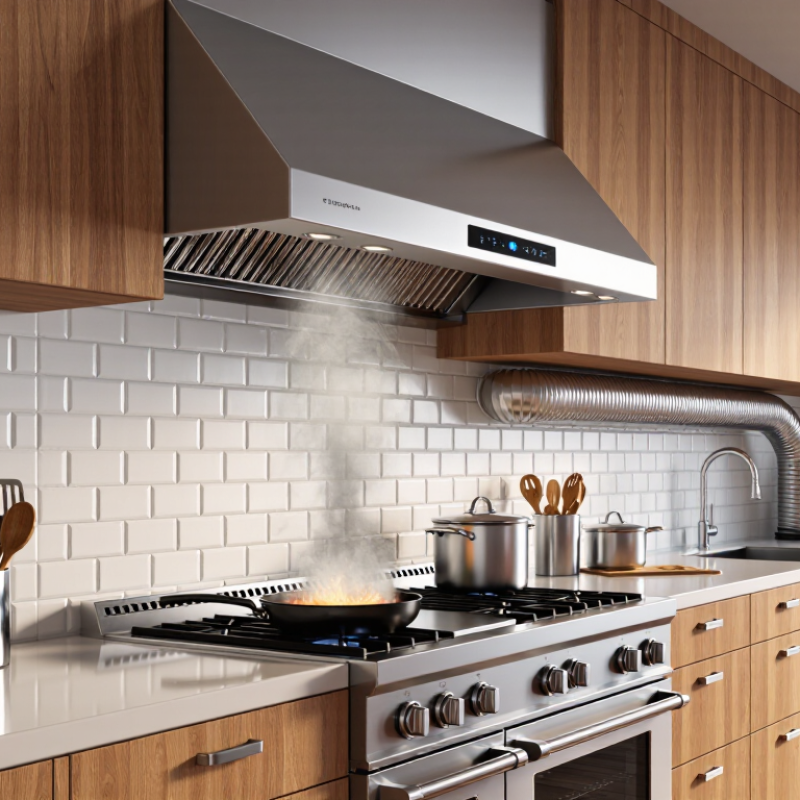
Determine Required Kitchen Ventilation: ASHRAE 62.2 Sets 100 CFM Intermittent or 5 ACH Continuous
Choosing a range exhaust starts with airflow, not appearance. ASHRAE Standard 62.2-2022 lists kitchen local-exhaust benchmarks of 100 CFM for intermittent operation or 5 air changes per hour (ACH) for continuous operation. These are different operating approaches, not numbers to add together. For a 10-by-12-foot kitchen with an 8-foot ceiling, the volume is 960 cubic feet; 5 ACH works out to 80 CFM continuously. Check which edition and requirements apply to your project.
The calculation is only a starting point. Duct length, bends, and filters add resistance, so installed airflow may differ from a hood’s advertised rating. The Home Ventilating Institute’s certified product directory provides tested airflow and sound data for comparing models. Read the rating details, and confirm the duct configuration matches your installation. A powerful fan can still perform poorly if it misses the rising plume from a front burner.
Tips: Keep the hood centered over the cooking surface, use the rear burners when practical, and run the fan while cooking. For a quick check, measure kitchen volume and multiply by five, then divide by 60 for continuous CFM. Don’t treat that estimate as the whole design. Makeup air, noise, and actual capture matter too. I’d verify the final setup after installation; the paper calculation can be a little too neat.
| Selection dimension | Guidance or example | How to use it |
|---|---|---|
| Ventilation baseline | ||
| Intermittent local kitchen exhaust | 100 CFM minimum reference rate | Use as the intermittent kitchen-exhaust benchmark in the applicable ASHRAE 62.2 provisions. Check the edition adopted by your local jurisdiction. |
| Continuous local kitchen exhaust | 5 air changes per hour (ACH) | Calculate airflow as kitchen volume × 5 ÷ 60. With volume in cubic feet, this equals kitchen volume ÷ 12 CFM. |
| Kitchen volume | Floor length × floor width × ceiling height | Measure the kitchen space in feet to estimate its volume in cubic feet. Confirm the measurement method against applicable local requirements. |
| Illustrative continuous-exhaust calculations | ||
| Compact kitchen | 8 × 10 × 8 ft = 640 ft³; 5 ACH = approximately 53 CFM | Calculation: 640 × 5 ÷ 60 = 53.3 CFM. This is the calculated continuous rate, not an intermittent rate. |
| Medium kitchen | 10 × 12 × 8 ft = 960 ft³; 5 ACH = 80 CFM | Calculation: 960 × 5 ÷ 60 = 80 CFM. |
| Large kitchen | 12 × 15 × 9 ft = 1,620 ft³; 5 ACH = 135 CFM | Calculation: 1,620 × 5 ÷ 60 = 135 CFM. |
| Range-hood selection checks | ||
| Operating mode | Intermittent or continuous | Choose the applicable ventilation approach first; do not treat the 100 CFM intermittent benchmark and the 5 ACH continuous calculation as identical operating rates. |
| Installed airflow | Account for duct length, elbows, duct diameter, filters, and termination | Compare the required airflow with performance information at the expected system resistance. A published airflow rating may not equal airflow after installation. |
| Hood coverage | Match hood width and depth to the cooking surface | A hood that adequately covers the cooking area can capture cooking pollutants more effectively than one that is undersized. |
| Noise and controls | Review sound ratings and available speed settings | Select a unit likely to be used consistently, and check sound performance at the airflow setting you expect to use. |
| Makeup air and local rules | Requirements vary by jurisdiction and installation | Confirm applicable building-code requirements, including any makeup-air provisions for higher exhaust airflow, before installation. |
Note: These examples illustrate the 5 ACH calculation and are not a substitute for checking the locally adopted standard, building code, or installation requirements. ASHRAE 62.2 provisions concern residential ventilation; local adoption and applicable editions can differ.
