2025 How to Master Control Systems Engineering for Optimal Performance
Control systems engineering is a crucial discipline that integrates science, technology, and mathematics to develop and optimize performance in various applications. According to renowned expert Dr. Emily Johnson, “Effective control systems are the backbone of advanced engineering solutions, enabling us to achieve precision and reliability in our designs.” As industries continue to evolve and embrace automation, mastering control systems engineering has become more important than ever for engineers seeking to enhance operational effectiveness.
In the pursuit of optimal performance, engineers must adopt a comprehensive understanding of the fundamental principles of control systems engineering. This field not only encompasses the theoretical frameworks that govern system dynamics, but also emphasizes practical skills in system design, analysis, and implementation. The implications of effective control systems reach far and wide, influencing performance outcomes in aerospace, manufacturing, robotics, and beyond.
As we look toward 2025, the importance of mastering control systems engineering cannot be overstated. Engineers equipped with the right knowledge and tools will play a pivotal role in driving innovation, improving efficiency, and ensuring the reliability of complex systems. This article aims to provide insights and strategies for mastering this critical field, paving the way for future advancements in technology and performance.

Understanding the Basics of Control Systems Engineering
Control systems engineering is a fundamental discipline that focuses on the behavior of dynamic systems and their control strategies. At its core, it involves understanding how to manipulate system inputs to achieve desired outputs while maintaining stability and efficiency. This requires a solid grasp of mathematical modeling, which is essential for analyzing system dynamics. Engineers often utilize differential equations, transfer functions, and state-space representations to describe system behavior accurately. By mastering these mathematical tools, engineers can design controllers that effectively respond to changes and uncertainties within the system.
Another key aspect of control systems engineering is the concept of feedback. Feedback mechanisms enable systems to self-correct and adjust based on performance metrics. This principle is evident in various real-world applications, from simple home heating systems to complex aerospace technologies. Understanding how to design and implement feedback loops is crucial for achieving optimal performance. Engineers must also consider various parameters, such as stability margins and transient response, when refining their control systems. By delving into these fundamental concepts, aspiring engineers can develop a robust foundation that will support their efforts in creating efficient and reliable control systems.
Key Principles of Control Theory for System Optimization
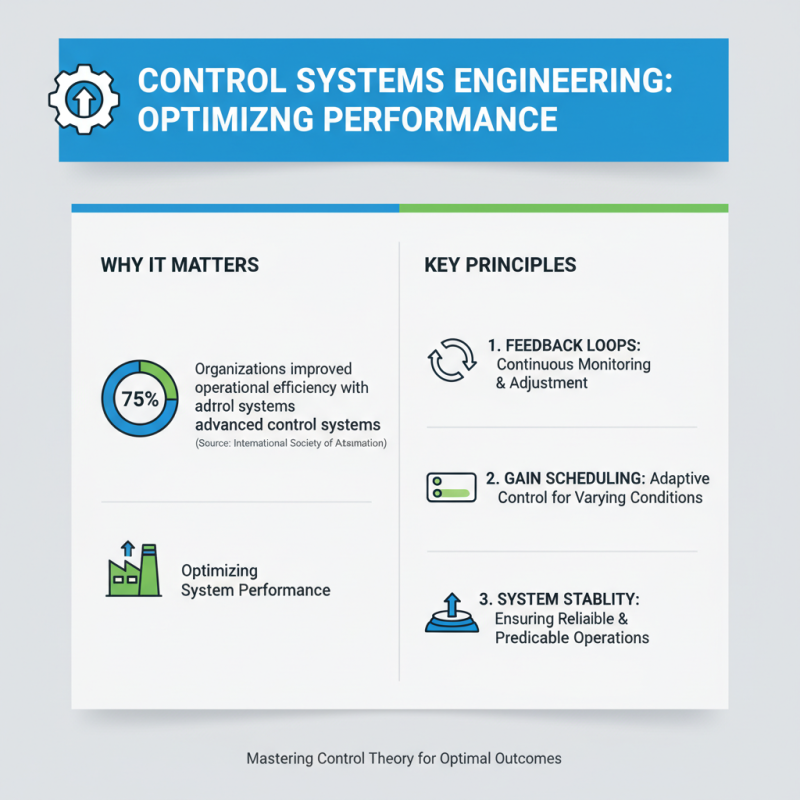
In recent years, the field of Control Systems Engineering has seen significant advancements, underscoring the importance of mastering control theory for optimizing system performance. According to the International Society of Automation, approximately 75% of organizations reported improved operational efficiency after implementing advanced control systems. Key principles of control theory, such as feedback loops, gain scheduling, and system stability, are vital for engineers aiming to fine-tune processes and achieve optimal outcomes.
Feedback control, which adjusts a system’s output based on its current state, remains a cornerstone of control theory. A study from the IEEE Control Systems Society indicated that systems utilizing feedback mechanisms can enhance responsiveness by up to 50%. Coupled with hierarchical and decentralized control strategies, these principles allow engineers to optimize complex systems, reduce energy consumption, and maintain system stability under varying operational conditions.
As industries evolve, the application of control theory in real-time systems continues to grow. The Automation Federation states that companies employing predictive control methods can achieve a 30% reduction in resource usage while improving overall system reliability. By mastering these key principles, engineers can ensure their systems operate at peak efficiency, ready to meet the demands of an increasingly automated world.
Designing Effective Control Strategies for Engineering Applications
Effective control strategies are essential for engineering applications, as they determine how systems respond to various inputs and disturbances. To design these strategies, engineers must first understand the system dynamics, which involves modeling and analyzing the behavior of the system under different conditions. This understanding allows for the identification of key variables and parameters that will influence the performance of the control system. With a well-defined model, engineers can apply various control techniques, such as PID control, state feedback, or adaptive control, depending on the specific needs of the application.
In addition to selecting the right control method, engineers must also consider the implementation of their designs. This includes the integration of sensors for real-time data collection and actuators for the precise execution of control commands. Moreover, engineers need to simulate their control strategies to evaluate their effectiveness before deployment. Techniques like root locus, Bode plots, and Nyquist criteria are invaluable tools for assessing stability and performance. By prioritizing thorough testing and iteration, engineers can refine their strategies to ensure optimal performance in the intended application, whether it's in automation, robotics, or any other engineering domain.
Advanced Techniques in Control System Analysis and Design
Control system analysis and design are fundamental disciplines in engineering that ensure systems operate efficiently and reliably. Advanced techniques in this field focus on optimizing performance through sophisticated mathematical modeling and simulation. One of the key methodologies involves the use of state-space representation, which allows engineers to capture the dynamic behavior of systems by converting differential equations into a format that is ripe for analysis. This approach not only provides insights into system stability but also facilitates the design of controllers that can enhance system responsiveness and accuracy.
Another advanced technique is the implementation of robust control strategies. These strategies account for uncertainties and variations in system parameters, ensuring that the control system maintains desired performance levels despite external disturbances. Techniques such as H-infinity control and sliding mode control provide tools for designing systems that are resilient to disturbances. By integrating these methods into control system design, engineers can create systems that achieve optimal performance in real-world applications, ultimately leading to increased efficiency and reliability in various engineering domains. Through a combination of sophisticated analysis, simulation, and robust design principles, mastering control systems engineering becomes an accessible goal for professionals aiming to excel in this critical field.
2025 How to Master Control Systems Engineering for Optimal Performance - Advanced Techniques in Control System Analysis and Design
| Technique |
Description |
Application Area |
Expected Outcome |
| PID Control Tuning |
Optimizing proportional, integral, and derivative parameters for improved stability. |
Industrial Automation |
Increased process stability and response time. |
| State-Space Representation |
Modeling dynamic systems using state variables to enable analysis and design. |
Robotics |
Enhanced system control and flexibility. |
| Root Locus Method |
Graphical method for analyzing how the roots of a system change with feedback gain. |
Control System Design |
Improved control performance and stability margins. |
| Frequency Response Analysis |
Evaluating system response to sinusoidal inputs to design controllers and filters. |
Signal Processing |
Better filter design and system robustness. |
| Controller Design using MATLAB |
Implementing control algorithms in MATLAB for simulation and design validation. |
Engineering Education |
Improved understanding and application of control theory. |
Measuring Performance and Validating Control System Performance
Measuring performance in control systems engineering is a critical aspect that ensures systems operate efficiently and meet intended operational requirements. According to a report from the International Society of Automation, approximately 30% of control systems fail to meet performance expectations due to inadequate measurement and validation techniques. This underscores the importance of robust performance metrics during the design and implementation phases. Key performance indicators (KPIs) such as stability, responsiveness, and error reduction provide a foundation for assessing whether a control system is achieving optimal performance.
Validation of control system performance not only determines how well a system meets its design specifications but also identifies areas for improvement. For instance, a study by the IEEE Control Systems Society revealed that systems with comprehensive validation protocols increased operational efficiency by up to 25%. Techniques such as simulation-based evaluations and real-time monitoring can effectively validate performance, ensuring that control systems adapt to changing conditions and maintain reliability. By focusing on continuous monitoring and iterative testing, engineers can refine control strategies and implement enhancements that drive performance optimization in complex industrial applications.