7 Tips for Choosing the Best Strap Latches for Your Business
Choosing Strap Latches for your business is about more than finding a part that fits. The right choice can help keep panels, doors, cases, and equipment secure during everyday use. A latch that works well in a showroom may behave differently on a vibrating machine or a frequently opened storage box. Small details matter. Strap length, material, mounting style, and operating force all affect fit and usability.
Start by considering what the latch must hold, how often people will use it, and where it will be installed. Measure the available space, check the mounting points, and think about exposure to moisture, dust, or temperature changes. Then compare materials, load guidance, adjustability, and replacement options. A stainless-steel model may suit some environments, while a coated or lighter option may be more practical elsewhere. There is no universal best choice. That is worth remembering.
These seven tips will help you assess options with clearer criteria, ask suppliers more useful questions, and avoid choosing by price or appearance alone. If possible, test a sample on the actual equipment before ordering in quantity. Check that it closes smoothly, stays secure, and remains accessible to the people who use it. It is easy to overlook comfort during selection. Later, that small oversight can become an everyday frustration. A careful comparison takes time, but it can support safer handling, smoother workflows, and more dependable equipment use.
Define Strap-Latch Types, Components, and Common Business Applications
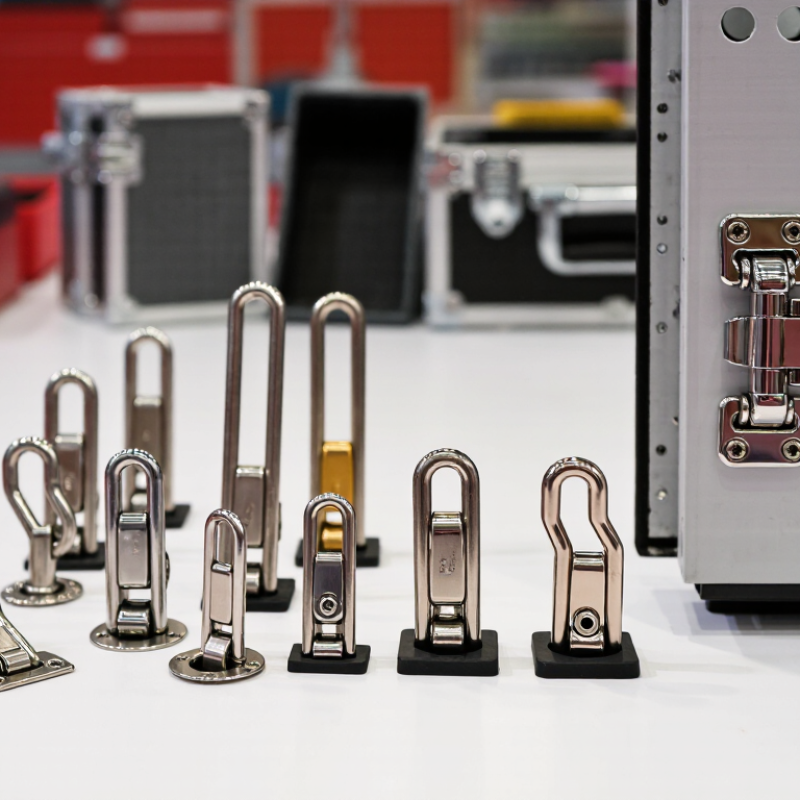
Strap latches secure a cover, door, or panel with a flexible metal band and a closing mechanism. Common types include over-center latches, adjustable draw latches, and spring-loaded versions. Over-center designs pull parts together firmly. Adjustable models accommodate small changes in gap or tension. A typical assembly includes a strap, catch, pivot, handle, and mounting plate. Material and finish matter: stainless steel resists corrosion, while coated steel may suit dry indoor equipment. Details vary by design.
Tip: Match the latch to the job, not just its listed load rating. A latch on a vibrating generator enclosure may need a locking feature and a secure catch. Tool cabinets, transport cases, production machinery, and access panels also use strap latches. Measure the closed gap and check how much movement occurs during use. A few millimeters can affect fit.
Tip: Test access and maintenance in real conditions. Operators wearing gloves may struggle with a small handle. If workers open a panel daily, ease of release matters as much as holding force. For outdoor equipment, inspect corrosion resistance and dirt buildup around the pivot. A latch can look suitable on paper and still feel awkward once installed. Trial fitting helps, though it takes extra time. Ensure mounting hardware suits the panel thickness and expected vibration.
7 Tips for Choosing the Best Strap Latches for Your Business
Compare common strap-latch configurations against typical business applications. Fit ratings are a qualitative guide, not measured performance data; actual suitability depends on the product design and operating conditions.
How to use this chart: Start with the application, then check the latch’s material, adjustment range, required tension, mounting method, and exposure to weather or chemicals. A typical strap-latch assembly may include a strap, a lever or buckle, a catch or hook, and mounting hardware; components vary by design. Ratings: 1 = limited typical fit, 2 = possible fit, 3 = common fit.
Match Rated Capacity to EN 12195-2 LC and STF Requirements
A strap latch may look sturdy, but appearance cannot tell you its working rating. Check the lashing label for LC, or lashing capacity, usually stated in daN under EN 12195-2. LC describes the lashing’s capacity in a straight pull; it is not the load’s weight limit. The complete assembly is only as strong as its weakest component, including the webbing, stitching, hooks, and latch.
STF, or standard tension force, matters when a strap is tightened over cargo to increase friction against the deck. A higher STF can create more clamping force, but only when the strap is tensioned correctly and the load’s contact surfaces support friction. Angles, surface conditions, and cargo shape affect the result. Small details matter. A dusty pallet or a strap routed over a sharp edge can change how the setup performs.
Match both values to the job, rather than choosing by buckle size or habit. For direct restraint, compare LC with the forces and lashing angles in your load-securing calculation. For top-over lashing, consider STF alongside friction and the number of straps required. Read the marking on each assembly; don’t assume two similar-looking straps share a rating. It is tempting to select extra capacity and move on. That can still leave poor routing or uneven tension, and I’d check those details again before dispatch.
Compare Corrosion-Test Results Using ISO 9227 Salt-Spray Data
When comparing strap latches, ask for complete ISO 9227 salt-spray reports, not just a headline number. The standard describes controlled test methods; it does not certify a latch or guarantee years of outdoor service. Check whether the report used neutral salt spray (NSS), the exposure duration, and the chamber conditions. Same test, same basis. That matters.
Compare like with like: base metal, coating type, coating thickness, and sample preparation should match the latch you plan to buy. Review when red rust first appeared, where it formed, and how many specimens were tested. A latch may look sound across its broad face while corrosion starts at a punched edge, rivet, or strap bend. Small details count. Ask whether those areas were included in the evaluation.
Use test results as a screening tool, then consider your actual conditions: coastal air, washdowns, indoor humidity, or occasional road salt. Salt-spray hours cannot be reliably converted into years of service life. Request photographs and the laboratory’s evaluation criteria, and compare reports using equivalent methods and endpoints. One caveat: production batches can vary, and one tested sample may not represent every shipment. If the report leaves that unclear, ask for more detail before choosing a latch.
Check Operating Force, Retention, and Manufacturer Cycle-Life Ratings
When choosing strap latches, check operating force with the panel in its actual position, not on a clean workbench. A latch that feels easy in hand may strain an operator when mounted overhead or behind equipment. Small detail. Ask daily users to open sample latches while wearing their usual work gloves. Note the effort, any pinch points, and whether the strap aligns without being pulled sideways. If several people struggle, the latch may be wrong for that application, even if its dimensions fit.
Retention matters under real conditions. Check whether the strap stays engaged when a door vibrates, flexes, or receives a light bump. Match the latch’s holding capacity to the panel, expected movement, and load; do not assume a firm closing feel proves secure retention. A simple trial on the assembled enclosure can reveal looseness that a bench test misses. That test is useful, but it is not a substitute for checking the manufacturer’s stated limits.
Review cycle-life ratings, and ask how the manufacturer tested them. A rating may depend on load, alignment, environment, and maintenance, so compare only figures based on similar conditions. Consider how often staff will operate the latch each shift, then allow a sensible margin above that duty. Ratings are estimates, not guarantees. I would not rely on one smooth demonstration; repeat the test with representative panels, and inspect straps and mounting points for wear. If results vary, document the conditions and ask for clarification before ordering.
7 Tips for Choosing the Best Strap Latches for Your Business — Check Operating Force, Retention, and Manufacturer Cycle-Life Ratings
| Tip | Selection Dimension | What to Check | How to Apply It |
| 1 | Operating force | Ask for the force needed to engage and release the latch, stated in newtons (N), and confirm how and where the force was measured. | Compare the measured force with the user’s capabilities and the available access space. Test samples in the actual mounting position; do not assume that a latch is easy to operate based on appearance alone. |
| 2 | Retention force | Request the rated holding or retention force in N, along with the loading direction and test setup. Retention force is different from operating force. | Set the required holding load from the application’s expected loads and safety requirements. Confirm that the rating applies to the complete latch-and-mounting arrangement, not just an isolated component. |
| 3 | Cycle-life rating | Check the manufacturer’s stated number of operating cycles and the test conditions, including load, environment, and what counted as a failure. | Compare the rating with expected use over the service period. For example, estimate annual cycles as daily operations × operating days per year, then discuss a suitable test margin with the manufacturer. |
| 4 | Load and strap fit | Verify the supported strap width, usable length, adjustment range, and any stated load limits. Check dimensions in millimetres (mm) against the equipment. | Measure the actual gap and attachment points, including expected movement or variation. Confirm that the strap can close securely without being stretched beyond its intended range. |
| 5 | Materials and environment | Identify the strap, latch, and mounting materials. Ask about suitability for moisture, chemicals, ultraviolet exposure, temperature, or corrosion where relevant. | Match documented material and environmental limits to the workplace. If exposure is uncertain, request compatibility information or test samples under representative conditions. |
| 6 | Mounting and alignment | Review the mounting-hole pattern, fastener requirements, installation clearances, and the allowable alignment range. | Check that the latch can be installed on the available panel or frame and that fasteners suit the substrate. Misalignment or loose mounting can affect operation and holding performance. |
| 7 | Inspection and replacement | Ask which parts are wear items and what inspection signs to look for, such as strap damage, deformation, loosened fasteners, or difficulty engaging. | Set an inspection and replacement process based on the application’s risk and usage. Replace a damaged or unreliable latch rather than relying on an unverified remaining cycle life. |
Selection note: Operating force, retention force, and cycle life depend on the specific latch design, installation, and test conditions. Use documented manufacturer data and application-specific testing; do not treat values from different test setups as directly comparable.
Assess Total Cost Using Service Life, Maintenance, and Replacement Data
A low purchase price can hide a costly latch choice. Compare total cost over a realistic service period, not just the invoice. Estimate how long each latch lasts under your actual conditions: opening frequency, load, moisture, dust, and vibration. A latch on a frequently used delivery case may wear faster than one on a rarely opened cabinet. That matters. Ask suppliers for service-life data and clarify how it was tested. If your use differs from the test conditions, treat the estimate cautiously.
Build a simple cost-per-year or cost-per-use comparison. Include purchase price, inspection time, lubrication or adjustment, replacement parts, and labor for fitting new latches. Add the cost of downtime if a failed closure delays work or leaves equipment unavailable. Keep a maintenance log with dates, cycle counts, and failure notes; even a basic spreadsheet can reveal patterns. This estimate will not be perfect. Staff may forget to record small repairs, and usage can change over time. Review the figures after a few months, then adjust your assumptions before ordering in bulk. A slightly higher-priced latch may prove less expensive if it needs fewer repairs and replacements.

