
Top 10 Types of Reinforcing Steel Bars for Global Buyers
reinforcing steel bars are the quiet framework behind bridges, apartment towers, ports, tunnels, and industrial floors. They rarely attract attention after concrete is poured. Yet their grade, rib pattern, diameter, ductility, and traceability can determine whether a structure performs safely under everyday loads and extreme events. The World Steel Association’s World Steel in Figures 2024 reports global crude steel production of approximately 1,888 million tonnes in 2023. Construction remains the industry’s largest steel-consuming sector. The scale is enormous, but procurement decisions still happen one bundle at a time.
This guide examines ten widely traded types of Reinforcing Steel Bars for global buyers. It considers common standards, including ASTM A615, ASTM A706, EN 10080, BS 4449, and ISO 6935-2. Each standard addresses different requirements for strength, elongation, welding, chemical composition, and dimensional control. A bar marked “500 MPa” is not automatically interchangeable across markets. That assumption causes expensive delays. Buyers should review mill test certificates, heat numbers, third-party inspection records, bend-test results, and coating thickness where corrosion protection is specified. The International Energy Agency and UNEP reported in the 2023 Global Status Report for Buildings and Construction that buildings and construction generated about 37% of global energy-related and process CO2 emissions in 2022. Material efficiency therefore matters, although lower carbon claims still require evidence.
A neat ranking can mislead. Coastal foundations, seismic frames, precast beams, and ordinary slabs may need very different bar properties. This overview is practical, but it cannot replace structural design or local code review. Experienced purchasing teams verify the details before comparing price, because the cheapest bundle may become the costliest mistake.
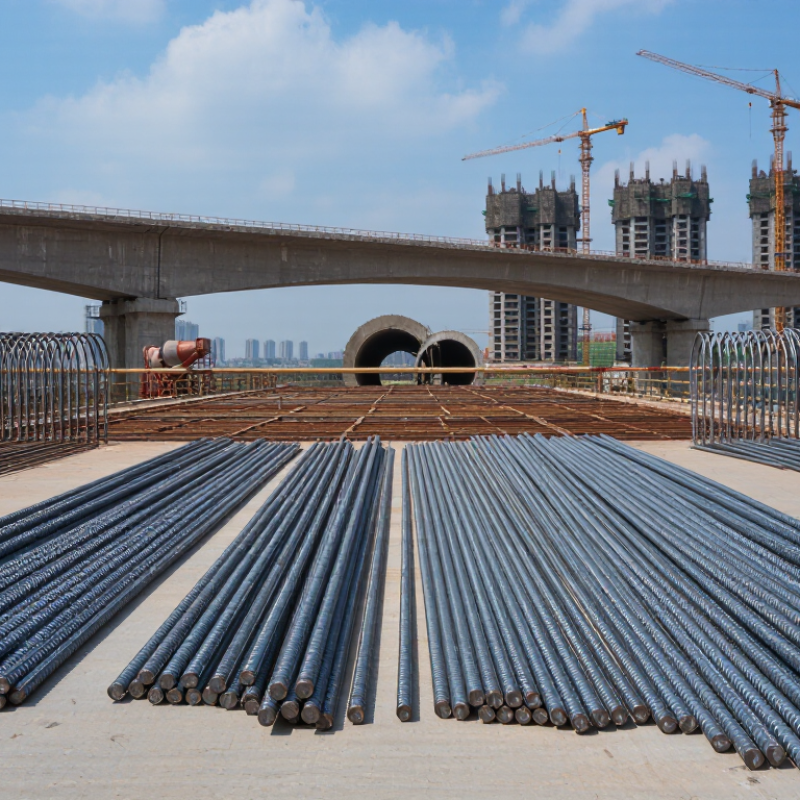
Define the Top 10 Rebar Types by Grade, Coating, Profile, and Application
Top 10 Types of Reinforcing Steel Bars for Global Buyers
Rebar selection starts with grade, coating, profile, and application. The World Steel Association reports 1,892.1 million tonnes of crude steel production in 2023. Infrastructure demand remains substantial, with the Global Infrastructure Hub estimating a $94 trillion investment need through 2040. Buyers should therefore compare performance, not only price.
The ten common choices include ASTM A615 Grade 60 carbon bars for general concrete frames; ASTM A706 Grade 60 weldable bars for seismic and welded structures; B500B bars for standard European construction; and B500C bars for higher ductility. Epoxy-coated bars resist chloride exposure. Galvanized bars provide stronger corrosion protection in outdoor concrete. Stainless steel bars suit marine decks and chemical environments. Ribbed bars improve concrete bonding. Plain round bars fit dowels, ties, and light fabrication. Threaded bars support mechanical connections and adjustable anchoring systems.
Profiles matter.
A rib pattern can improve anchorage, but poor detailing still causes cracking. Coating thickness, bend radius, mill certificates, and tensile results require careful checking. ASTM, EN, and project specifications are not interchangeable. This point is often underestimated. Buyers should also verify heat numbers, weldability, and local seismic requirements before shipment. Categories overlap, and one bar may satisfy several descriptions. That makes a simple “top ten” useful, but never fully sufficient.

Top 10 Types of Reinforcing Steel Bars for Global Buyers
Rebar types defined by grade, coating, profile, standard, and typical application
| No. | Rebar Type | Common Standard | Typical Grade | Minimum Yield Strength | Coating / Material | Profile | Typical Application | Key Purchasing Consideration |
|---|---|---|---|---|---|---|---|---|
| 1 | Plain Round Reinforcing Bar | ASTM A615/A615M | Grade 40 or Grade 60 | 40 or 60 ksi (275 or 420 MPa) | Uncoated carbon steel | Smooth, round surface | Dowels, ties, hoops, light structural reinforcement, and applications requiring easy bending | Plain bars provide less mechanical bond with concrete than deformed bars and may be restricted for main reinforcement. |
| 2 | Standard Deformed Carbon-Steel Bar | ASTM A615/A615M | Grade 60 | 60 ksi (420 MPa) | Uncoated carbon steel | Transverse ribs and longitudinal ribs | General reinforced-concrete buildings, foundations, bridges, slabs, columns, and beams | A widely specified general-purpose option; confirm bar size, test requirements, chemical limits, and project acceptance standard. |
| 3 | Weldable Low-Alloy Deformed Bar | ASTM A706/A706M | Grade 60 | 60 ksi (420 MPa) | Uncoated low-alloy steel | Deformed ribbed surface | Seismic structures, heavily reinforced members, and projects requiring controlled weldability | Controlled chemistry and enhanced ductility support welding and seismic detailing; welding procedures still require engineering approval. |
| 4 | High-Ductility Ribbed Bar | BS 4449 | B500B | 500 MPa | Uncoated carbon steel | Ribbed, rolled deformation pattern | General building, infrastructure, precast, and reinforced-concrete construction using British or related specifications | Check characteristic strength, ductility class, bond geometry, and certification to the current edition of the specified standard. |
| 5 | Seismic-Ductility Ribbed Bar | BS 4449 | B500C | 500 MPa | Uncoated carbon steel | Ribbed, rolled deformation pattern | Seismic zones, ductile frames, bridges, and structures subject to significant cyclic loading | Higher ductility requirements than B500B make it suitable where seismic or cyclic-load design rules specify Class C reinforcement. |
| 6 | European High-Strength Ribbed Bar | EN 10080 | B500B | 500 MPa | Uncoated weldable steel | Ribbed bar with defined bond geometry | Commercial buildings, industrial facilities, housing, foundations, and European-standard infrastructure | EN 10080 is a product standard; national design rules may define additional requirements for calculation, welding, and conformity assessment. |
| 7 | European Seismic-Ductility Ribbed Bar | EN 10080 | B500C | 500 MPa | Uncoated weldable steel | Ribbed bar with enhanced ductility | Seismic-resistant buildings, bridges, energy facilities, and structures requiring high deformation capacity | Class C generally provides higher ductility than Class B; verify the required elongation and tensile-to-yield ratio in the project specification. |
| 8 | Epoxy-Coated Deformed Bar | ASTM A775/A775M | Usually ASTM A615 or A706 Grade 60 | Normally 60 ksi (420 MPa) | Fusion-bonded epoxy coating | Deformed bar with coated ribs | Bridge decks, parking structures, marine-adjacent concrete, and slabs exposed to deicing salts | Inspect coating continuity, thickness, adhesion, handling damage, patching procedures, and compatibility with bending operations. |
| 9 | Galvanized Deformed Bar | ASTM A767/A767M | Usually ASTM A615 or A706 Grade 60 | Normally 60 ksi (420 MPa) | Hot-dip zinc coating | Deformed bar with zinc coating | Outdoor structures, coastal construction, parking garages, drainage systems, and exposed concrete | Specify zinc coating class or mass, surface preparation, fabrication sequence, and repair requirements after cutting or handling. |
| 10 | Stainless-Steel Reinforcing Bar | ASTM A955/A955M | Commonly Type 304 or Type 316/316L | Varies by grade and product class | Solid stainless steel | Plain or deformed stainless-steel bar | Marine structures, water-treatment facilities, tunnels, chemical environments, and long-life infrastructure | Higher initial cost is offset by strong corrosion resistance; select the stainless grade according to chloride exposure and service-life requirements. |
Buyer note: Yield-strength values shown are typical minimum values for the listed grade or product class. Grade equivalence is not automatic across ASTM, EN, and BS systems; always confirm the governing design code, chemical composition, ductility, weldability, bar diameter, rib geometry, testing, and certification requirements before purchase.
Compare Plain and Deformed Bars Using ASTM A615 Grades 40, 60, and 80
For global buyers, reinforcing steel selection starts with a practical distinction: plain bars have smooth surfaces, while deformed bars use ribs for stronger mechanical anchorage in concrete. ASTM A615/A615M covers both forms of carbon-steel reinforcement. It specifies chemical, mechanical, dimensional, and testing requirements. That detail matters at the receiving yard. A bar can look acceptable yet fail a tensile test.
Grade 40 provides a minimum yield strength of 40 ksi (280 MPa), Grade 60 reaches 60 ksi (420 MPa), and Grade 80 reaches 80 ksi (550 MPa). Deformed Grade 60 remains common for reinforced beams, slabs, and columns. Grade 80 may reduce steel congestion, but engineers must verify ductility, development length, and seismic requirements. Plain bars can suit dowels, hoops, or applications requiring easier bending, though their smooth surface provides weaker bond. They are not an automatic substitute for deformed reinforcement.
Site inspection experience shows why buyers should compare nominal diameter, mass tolerance, bend performance, heat numbers, and certified test reports. Check whether the stated grade matches project drawings and local acceptance rules. Do not rely on color codes alone. Ask for independent inspection when shipment value or distance justifies it. Welding needs separate review because A615 chemistry may not address every welding condition. Real projects are rarely tidy. One overlooked millimeter can disrupt spacing, while one missing document can delay approval. Grade 80 sounds better, but stronger is not always more suitable.
Match Weldable Rebar to ASTM A706 and B500B/B500C Strength Classes
Top 10 Types of Reinforcing Steel Bars for Global Buyers
Match Weldable Rebar to ASTM A706 and B500B/B500C Strength Classes
For global buyers, weldable rebar selection starts with chemistry, not catalog wording. ASTM A706 controls alloy content to support welding and predictable mechanical performance. B500B and B500C belong to a different classification system, despite their 500 MPa yield designation. B500C generally offers greater ductility than B500B, which can matter in seismic detailing. The grades are not automatic equivalents.
A useful match compares yield strength, tensile-to-yield ratio, elongation, bend performance, and carbon equivalent. Request the mill certificate, heat number, chemical analysis, and mechanical test results before purchase. For A706, verify the specified grade, because Grade 60 and Grade 80 have different strength levels. For B500B or B500C, confirm the applicable EN 10080 requirements and project design standard. Do not rely on the word “weldable” alone. It is too vague.
At the jobsite, remove oil, loose rust, and moisture from the joint area. Use a qualified welding procedure suited to bar diameter, joint type, and actual chemistry. Preheating may be necessary, but it should follow the approved procedure, not habit. Inspectors should check weld appearance, dimensions, and testing records, while engineers verify seismic detailing. A neat spreadsheet can still mislead when certificates describe nominal values rather than each heat. That small gap deserves attention.
Assess Epoxy, Galvanized, Stainless, and Low-Alloy Bars for Corrosion Risk
For global buyers, reinforcing steel bars should be selected by corrosion exposure, not strength alone. The common top ten categories include carbon, micro-alloyed, high-strength, low-alloy, weathering, epoxy-coated, galvanized, stainless, quenched-tempered, and zinc-rich bars. Each behaves differently near coastlines, chemical plants, and roads using de-icing salts. Epoxy-coated bars provide a protective barrier, but scratches during transport can expose bare steel. Galvanized bars offer stronger handling tolerance, although cutting and welding may damage the zinc layer. Stainless bars resist chloride attack best, but their purchase cost is considerably higher.
Low-alloy bars can improve toughness and atmospheric resistance, yet they are not automatically suitable for marine concrete. Their performance depends on alloy chemistry, concrete cover, moisture, and construction quality. In field inspections, poor storage often creates avoidable rust before installation. Surface discoloration is not always structural failure, but deep pitting deserves professional review. Some specifications also overlook compatibility between coatings, couplers, and welding procedures. That omission can create problems later.
Tips: Ask suppliers for mill certificates, coating thickness data, bend-test results, and salt-spray or corrosion evidence. Check whether the proposed bar matches local standards and the project’s exposure class. Inspect bundles after arrival, especially at cut ends and tie-wire contact points. Avoid choosing stainless steel everywhere without a lifecycle-cost comparison. It may be excessive in sheltered indoor structures. A small trial section can reveal installation damage before large-scale placement.
Top 10 Types of Reinforcing Steel Bars for Global Buyers
Assess Epoxy, Galvanized, Stainless, and Low-Alloy Bars for Corrosion Risk
The chart uses an indicative corrosion-resistance index from 1 to 5, where 5 represents the strongest expected resistance in aggressive chloride or marine exposure. Stainless steel grades generally provide the highest resistance, while epoxy-coated and galvanized bars offer protection through coatings. Plain carbon and conventional low-alloy bars normally require concrete quality, adequate cover, and additional protection in corrosive environments. Actual performance depends on coating damage, chloride concentration, moisture, temperature, fabrication, and installation quality; the index is a comparative guide rather than a standardized test result.
Calculate Rebar Mass with 0.006165d² kg/m and Verify Global Standards
Top 10 Types of Reinforcing Steel Bars for Global Buyers
Reinforcing bars differ by surface, grade, coating, and application. Common types include plain round bars, deformed bars, high-strength bars, welded wire reinforcement, galvanized bars, epoxy-coated bars, stainless steel bars, threaded bars, quenched-and-tempered bars, and corrosion-resistant alloy bars. For international purchasing, steel type alone is not enough. Diameter, yield strength, rib pattern, ductility, and certification must match the project specification.
Calculate theoretical mass with 0.006165d² kg/m, where d is the nominal diameter in millimetres. A 16 mm bar weighs about 1.578 kg/m. A 12 m bar therefore weighs approximately 18.94 kg. This calculation helps buyers compare quotations, estimate shipping weight, and detect obvious quantity errors. However, it is only a theoretical value. Manufacturing tolerances, rib geometry, and cutting variation can affect the delivered mass.
Tips: Ask for the mill test certificate, dimensional inspection report, and traceability records. Confirm whether the supplier follows ASTM A615, BS 4449, EN 10080, JIS G3112, or another required standard. Do not assume that similar grades are interchangeable. Check yield strength, tensile ratio, elongation, bend performance, and chemical limits. Small details matter. In practice, buyers sometimes focus too heavily on price and overlook bundle labels or heat numbers. That mistake can delay inspection and create costly rework. Recheck the formula, units, and actual scale weight before approving shipment.

