
Why Choose Flame Retardant Cable for Global Projects?
Why Choose Flame Retardant Cable for Global Projects?
Global construction projects face different fire risks, building designs, climate conditions, and installation practices. Flame Retardant Cable helps reduce flame spread along cable routes, especially inside risers, tunnels, transport hubs, and crowded commercial buildings. It does not make a system fireproof. That distinction matters.
Professor Richard Hull, a respected fire-science author, explains, “Fire is a chemical reaction, not a thing.” His observation reminds engineers that cable performance depends on materials, heat, oxygen, installation, and surrounding products. A cable must be evaluated within the complete fire system, not judged by its label alone.
In real projects, the details are visible. A cable tray may cross several floors. Smoke may enter a protected escape route. A damaged outer sheath may expose insulation to heat. Flame Retardant Cable can help limit fire propagation, while low-smoke and halogen-free designs may reduce harmful emissions in enclosed spaces. However, performance depends on verified testing and correct installation.
International buyers should review test reports, temperature ratings, conductor construction, sheath materials, and traceable manufacturing records. Relevant standards may include IEC, EN, BS, or local project requirements. Requirements differ between markets, and one certificate may not satisfy every authority.
There is no universal cable choice.
A practical selection balances fire behavior, electrical load, mechanical strength, moisture exposure, installation method, and long-term maintenance. Cost remains important, but replacement after a fire can be far more disruptive. Some project decisions will still involve uncertainty. That is why transparent technical evidence, independent testing, and experienced engineering review should guide every global specification.
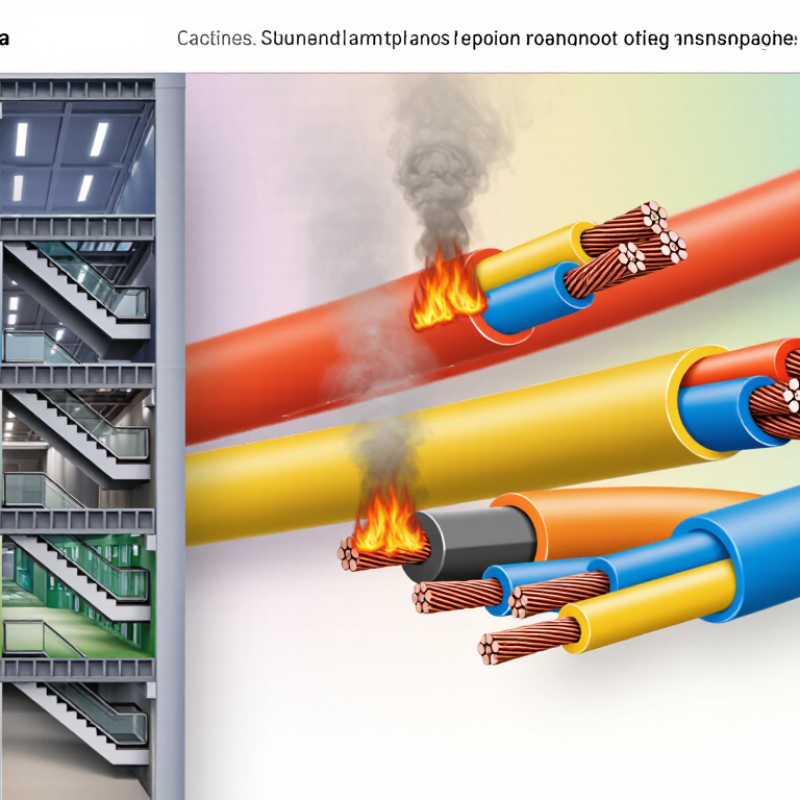
What Is Flame Retardant Cable and How Does It Work?
Flame retardant cable is designed to resist ignition and limit flame spread along its length. Its insulation and sheath contain flame-retardant materials that interrupt combustion. When heated, these compounds can dilute flammable gases, form protective char, or reduce contact with oxygen. The exact reaction depends on the cable construction.
It is not fireproof. That distinction matters.
IEC 60332 tests examine whether flames spread along a cable under controlled conditions. IEC 60754 evaluates acidic gas emissions, while IEC 61034 measures smoke density. These tests help engineers compare performance, but they do not recreate every tunnel, plant, or high-rise environment. Installation quality still matters greatly. A damaged sheath or tightly packed cable tray can change fire behavior.
NFPA’s Fire Loss in the United States During 2023 reported about 1.39 million fires and approximately 22.9 billion dollars in property damage. The figure is not cable-specific, but it shows why fire-limiting materials remain important in global construction. Project teams should check voltage ratings, conductor size, smoke requirements, and national approvals together. A cable selected only by price may create hidden risk. That is an uncomfortable lesson, yet it is often overlooked.
Why Choose Flame Retardant Cable for Global Projects? - What Is Flame Retardant Cable and How Does It Work?
| Technical Dimension | What It Means | Key Facts and Typical Requirements | Value for Global Projects |
|---|---|---|---|
| Primary Function | Limits flame spread along the cable | Flame-retardant cables are designed to resist ignition and reduce the propagation of fire when exposed to a flame. They do not necessarily maintain circuit operation during a fire. | Helps prevent a localized cable fire from spreading rapidly through cable routes. |
| How the Cable Works | Material formulation and cable construction | Special insulation, sheath, fillers, tapes, or compounds can reduce heat release, slow flame travel, and promote self-extinguishing behavior after the ignition source is removed. | Supports safer cable containment in buildings, industrial facilities, transport systems, and infrastructure projects. |
| Single-Cable Flame Test | Resistance to vertical flame propagation | IEC 60332-1-2 specifies a vertical flame propagation test for a single insulated wire or cable using a defined flame application procedure. | Provides a common baseline for evaluating individual cables used in international projects. |
| Bunched-Cable Flame Test | Performance when several cables are installed together | IEC 60332-3 series tests flame spread on vertically mounted bunched cables. Different categories use defined cable quantities and test durations. | More closely reflects cable trays, risers, shafts, and densely packed installation environments. |
| Low Smoke Performance | Amount of smoke produced during burning | Low-smoke cable designs are commonly evaluated using IEC 61034-2, which measures light transmittance in a smoke chamber. Lower smoke can improve visibility during evacuation. | Important for enclosed public areas, tunnels, stations, data facilities, and high-occupancy buildings. |
| Halogen-Free Performance | Reduction of corrosive acidic gases | Halogen-free, low-smoke materials are commonly assessed for halogen acid gas emission under IEC 60754-1 and acidity and conductivity under IEC 60754-2. | Can reduce corrosive damage to electronic equipment and metal structures during a fire. |
| Fire Resistance vs. Flame Retardance | Different safety functions | Flame retardance limits flame spread. Fire-resistant or circuit-integrity cables are designed to continue operating for a specified period under fire conditions and require separate system-level testing. | Helps project teams select the correct cable for alarms, emergency lighting, pumps, controls, and ordinary power circuits. |
| Common Conductor Materials | Electrical current-carrying element | Copper and aluminium are widely used conductor materials. The selection depends on conductivity, weight, installation method, mechanical requirements, and applicable electrical codes. | Allows the cable design to be adapted to regional engineering and installation requirements. |
| Operating Temperature | Permitted continuous conductor temperature | Typical ratings depend on the insulation system and product design. Common thermoplastic and thermoset cable systems may have continuous conductor ratings such as 70°C or 90°C, but the exact rating must be verified from the product specification. | Supports correct ampacity calculations and prevents premature insulation aging. |
| Voltage Rating | Maximum intended system voltage | Cables are manufactured for defined voltage classes, such as 300/500 V, 450/750 V, or 0.6/1 kV. The selected rating must match the electrical system and local regulations. | Improves compatibility across different power distribution systems and project locations. |
| Installation Environment | Conditions surrounding the cable | Selection should consider indoor or outdoor use, moisture, ultraviolet exposure, oil, chemicals, mechanical impact, bending, burial, conduit, and cable-tray installation. | Reduces the risk of premature failure caused by environmental exposure rather than electrical loading. |
| International Compliance | Verification against recognized standards | Project specifications may reference IEC, EN, BS, NEC, or other national and regional requirements. Compliance should be confirmed through the applicable test reports, declarations, and installation rules. | Simplifies technical review and helps avoid non-compliance when equipment crosses national borders. |
| Construction Consistency | Repeatability of cable performance | Conductor size, insulation thickness, sheath material, concentricity, and manufacturing tolerances affect electrical and fire performance. Independent testing and documented quality control provide supporting evidence. | Improves reliability in large projects with long cable runs and multiple installation teams. |
| Typical Applications | Where flame spread control is important | Common applications include commercial buildings, hospitals, schools, transportation facilities, industrial plants, renewable-energy sites, communication rooms, tunnels, and public infrastructure. | Provides a practical safety upgrade for installations where cable fire propagation could affect people, assets, or service continuity. |
| Selection Check | Information to confirm before procurement | Verify conductor size, voltage rating, temperature rating, flame test, smoke and halogen performance, mechanical properties, environmental suitability, installation method, and local approval requirements. | Reduces specification gaps, substitution risks, and delays during international procurement and inspection. |
Note: Flame-retardant performance, low-smoke performance, halogen-free performance, and fire resistance are separate properties. The applicable cable standard, test method, installation condition, and project code should always be confirmed before selection.
