2026 Best PLC Control Systems for Industrial Buyers?
Choosing a PLC control system in 2026 is less about picking the most familiar brand and more about matching hardware to the plant’s real operating needs. A packaging line with frequent changeovers has different demands from a water-treatment facility running steady processes. Start with the basics: required I/O, expected scan times, network protocols, expansion plans, and the conditions inside the control cabinet. Small details matter. A few extra modules can affect cabinet space, wiring time, and the cost of future changes.
This guide compares leading PLC platforms through practical buying criteria, including programming tools, integration options, safety features, vendor support, spare-part availability, and lifecycle expectations. It also considers how well each system fits new installations and upgrades to existing equipment. Check the specifications against your own application, and verify compatibility with the sensors, drives, and supervisory software already in place. A polished brochure cannot settle those questions. Neither can a ranking alone.
There is no universal winner. A system that suits a large, connected plant may be unnecessarily complex for a small machine builder. Some trade-offs are easy to miss until commissioning begins, and published product details can change. Treat this overview as a starting point, then confirm current documentation and support with the manufacturer or an experienced integrator. The best choice is the one your team can maintain reliably—not simply the one with the longest feature list.
How PLC Control Systems Operate in Industrial Automation
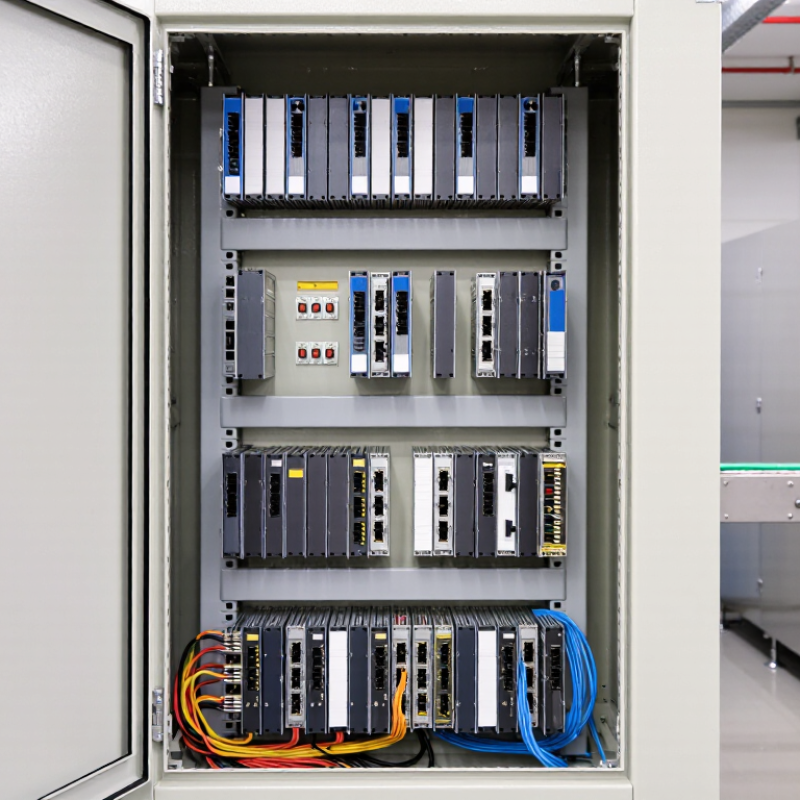
A PLC control system repeatedly reads inputs, runs programmed logic, and updates outputs. A sensor may detect a bottle at a filling station; the PLC checks its position, then signals a valve to open. This scan repeats in milliseconds, though timing depends on the controller, program, and network. Operators monitor conditions through an HMI, while alarms and diagnostics help identify faults. Simple in principle. Real lines are less tidy.
The International Federation of Robotics’ World Robotics 2024 report counted 4,281,585 industrial robots operating worldwide in 2023. In a robotic cell, PLCs coordinate signals from sensors, drives, conveyors, and safety devices. That coordination needs clear sequencing and predictable response times. A robot count does not measure PLC use, but it illustrates the growing complexity of automated production. For industrial buyers, check supported I/O, communication protocols, scan-time requirements, and diagnostic features against the actual process. Also confirm whether safety functions require a separate safety-rated controller. A practical warning: more features do not automatically mean better control. Test the intended sequence with realistic sensor delays and fault conditions; commissioning often reveals assumptions the design team missed.
Which PLC Architectures Suit Different Industrial Applications?
PLC architecture should follow the process, not a feature checklist. A standalone controller suits a compact machine with a few drives, local sensors, and one operator station. It keeps wiring and troubleshooting straightforward. Keep it simple. For a packaging line or material-handling system, distributed control with remote I/O can reduce long cable runs and isolate faults by zone. A cell-based design also lets technicians service one section while others keep running, when the process allows it.
For continuous production, use coordinated controllers, redundant networks, and carefully planned failover. Safety functions need a validated safety architecture, not ordinary control logic alone.
The International Federation of Robotics’ World Robotics 2024 report counted 4,281,585 industrial robots operating worldwide in 2023, underscoring the need for reliable machine-to-line coordination.
That matters. Edge-connected PLCs can support condition monitoring and production data collection, but they add configuration and cybersecurity work. Match data access to actual maintenance needs.
A detail buyers often miss: distributed I/O can simplify installation yet complicate fault-finding without clear labeling and network diagnostics. I would not choose redundancy by default; for a small, noncritical machine, it may add cost without meaningful uptime gains.
What Criteria Matter When Comparing PLC Systems in 2026?
Choosing a PLC in 2026 starts with the process, not the brochure. List required inputs and outputs, including spare capacity for likely additions. Check scan time under realistic workloads, not only ideal conditions. A fast response on paper may not help if network delays or overloaded tasks slow the whole cell. That matters.
Next, assess integration and maintenance. Confirm support for the plant’s sensors, drives, safety devices, and communication protocols. Ask how technicians will diagnose faults: clear status indicators and useful event logs can shorten downtime. Review programming tools, training needs, backup procedures, and how long replacement parts are expected to remain available. Small details count. A cabinet label that matches the controller’s diagnostics can save minutes during a night shift.
Environmental limits deserve equal attention. Compare temperature, vibration, electrical noise, and enclosure requirements against the actual installation site. Then estimate total ownership cost, including engineering time, licenses, spares, and future expansion. There is no universal winner. A system with extra capacity may be wasteful on a simple machine, while a low-cost unit can become difficult to maintain across several production lines. Even a careful scorecard has blind spots; pilot testing with real workloads often reveals assumptions the specification sheet misses.
How Do PLC Platforms Differ in Integration and Scalability?
A PLC platform’s integration is shaped by more than its communication ports. Check whether it can exchange data with existing drives, sensors, operator panels, and plant software. A gateway may connect older equipment, but it can add configuration work and another point to troubleshoot. Test a small set of real signals before committing: a motor speed, an alarm, and a production count reveal more than a feature list.
Scalability depends on how easily the system can grow in I/O, processing capacity, and network load. A line that starts with two cabinets may later need remote stations or added safety functions. Ask how expansion affects programming, diagnostics, spare parts, and staff training. In practice, the neatest architecture is not always the easiest to maintain. One detail is easy to miss: inconsistent tag names can slow every later integration.
Tips: Map current and planned connections before comparing platforms. Confirm protocol support, licensing limits, and expansion capacity in writing. Then test a sample configuration with the engineers who will maintain it. Keep the test modest. A short trial may expose an awkward workflow that a polished presentation hides.
2026 PLC Control Systems: Integration and Scalability
How do common PLC architectures compare as industrial control needs grow?
Indicative qualitative ratings: 1 = limited, 5 = high. These are general architecture-level comparisons, not product benchmarks; actual capabilities depend on the controller, selected modules, software, network design, and system sizing.
How Should Buyers Assess Cost, Support, and Lifecycle Needs?
A PLC’s purchase price is only one part of its cost. Compare the controller, I/O modules, licenses, engineering time, and commissioning labor. Ask for a written estimate that separates these items. Downtime costs more.
Support terms matter when a line stops at 2 a.m. Check response hours, remote troubleshooting options, and the availability of replacement modules. Ask who handles software changes after handover. A quick phone response is useful, but it cannot replace clear escalation steps. Test the support process before production, if possible.
Consider the system’s expected service life and likely changes to the process. Confirm how firmware updates are managed and whether older modules will remain available. Estimate the effort needed to migrate programs and train maintenance staff. A spreadsheet may look precise, yet labor assumptions are often guesses. Plan for change. Record those uncertainties, then revisit them with the people who will maintain the equipment.
Related Posts
-
Best PLC Control System Manufacturers in China
-

How to Choose the Right Electrical Control Panel?
-
5 Best Electrical Control Panel Suppliers for Global Buyers
-
China Top Automation Control Panel Manufacturers
-
10 Best PLC Control Panel Manufacturers in 2026?
-

7 Tips for Choosing the Right PLC Control Panel